









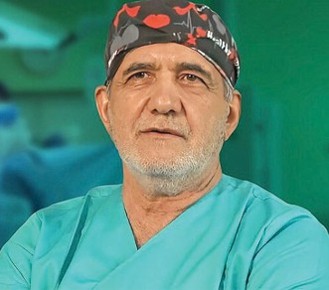

was sentenced to 10 years in prison Sunday for allegedly spying for Israel.
Nature magazine reported he was one of 10 to 15 people tried simultaneously for allegedly working for Israel’s intelligence agency, Mossad.
Iran has announced that trial, but has not identified any of those on trial. Nature did not say how it learned Kokabee was part of that tria, but the magazine has been closely following the Kokabee case because it is a science publication and he is a scientist.
Nature said Kokabee was sentenced by Judge Abol-Qasem Salavati, who is well-known for handling political cases at Tehran’s Revolutionary Courts.
Kokabee, 29, previously worked on the physics of optics at the Institute of Photonic Sciences (ICFO) in Barcelona, Spain. More recently, he was at the University of Texas in Austin before he was arrested on a visit home in February 2011 on charges of “communicating with a hostile government” and “illegal earnings.”
Nature reported that close contacts of Kokabee in Iran said no evidence was presented at the trial to justify the verdict. Whereas other prisoners in the group declared themselves guilty in a television broadcast the evening before the trial, Kokabee denied all the charges and refused to speak in court. He plans to appeal the sentence, those contacts told Nature.
Numerous science organizations have written to the Iranian authorities asserting Kokabee’s innocence and asking for a fair trial, including: the Committee of Concerned Scientists, a human-rights group based in New York; the American Physical Society in College Park, Maryland; and a group of four international optics organizations. His case has been included as a cause for concern in the report of Ahmed Shaheed, the United Nations Special Rapporteur on human rights in Iran.
In an open letter written from prison, Kokabee claimed that the authorities were trying to obtain his “collaboration” through threats to him and his family; in another, he insisted that he was not a political activist, something that his friends confirm.
Kokabee’s friends have speculated that his frequent trips to Iran — totaling four or five in 2010 — may have aroused the suspicions of the Iranian authorities.
Hadi Ghaemi, a physicist previously at the City University in New York and now director of the International Campaign for Human Rights in Iran (ICHRI), said, “This will send chills through the Iranian higher-education system, particularly scholars and students who seek to enhance and expand their horizons abroad.” Some speculated that might have been the purpose of the prosecution of Kokabee.
According to Kaleme website, Kokabee, a Sunni Turkmen, may have been arrested in an effort to discourage the academic pursuits of ethnic and religious minorities in Iran.
A 2005 graduate of Sharif University of Technology in Tehran, Kokabee was 29th in the Konkoor examination, the national university entrance examination taken by tens of thousands of high school graduates in Iran.
He worked for several Iranian companies, including the National Iranian Oil Company, before leaving the country in 2007. From then until 2010 when he moved to Austin, he was in Barcelona studying lasers and optical parametric oscillators, pump laser beams that can change photons to different wavelengths.
While Kokabee is often described as a student of nuclear physics, John Keto, one of his academic advisers in Texas, said he was studying optics in the physics department in Texas and had previously specialized in lasers, but had never been involved in nuclear studies.