













This tactic will make it harder for the United States to know who is buying Iranian oil and thus where to apply sanctions after June 28, when the new US sanctions take effect.
The United States has been focusing on 11 non-European countries that bought Iranian crude last year and is pressing them at least to reduce purchases of Iranian oil. But Iran may well be luring new customers with offers of better credit terms or outright discounts, which means the United States really needs to know where all 193 countries around the world are buying their oil.
Because European firms will no longer be able to insure or re-insure tankers after July 1, Iranian-owned tankers will probably be carrying most of Iran’s oil exports by then, so tracking where those tankers are going is key.
But Reuters reported last week that most of Iran’s fleet of 39 tankers are now blacked-out after Tehran presumably ordered captains in the National Iranian Tanker Co (NITC) to switch off the black box transponders that are used in the shipping industry to monitor vessel movements.
“Iran, helped by its customers, is trying to obfuscate as much as possible,” a senior executive at a national oil company that has done business with Iran told Reuters. Reuters said oil industry, trading and shipping sources all confirmed the Iranian tactic.
Reuters said it conducted a survey of the Iranian fleet via the ship tracking system AIS (Automatic Identification System) Live and found only seven of Iran’s 25 very large crude carriers (VLCC) are still operating on-board transponders. And only two of NITC’s nine smaller Suezmax size tankers have their tracking systems in operation, shipping sources told Reuters.
“NITC oil tankers are going to operate in stealth mode,” said a shipping official, who declined to be identified. One unanswered question is why nine of Iran’s tankers, a quarter of the fleet, haven’t yet turned off their transponders.
Ships are obliged by international law to have a satellite-tracking device on board when traveling at sea. However, a ships’ master has the discretion to turn off the device on safety grounds with the permission on the vessel’s flag state.
Last year, during the Libyan civil war, some tankers are known to have turned off their trackers to avoid detection and allow them load crude from the Qaddafi government.
The tanker blackouts make it increasingly difficult to gauge how much oil is moving out of Iran’s export terminals.
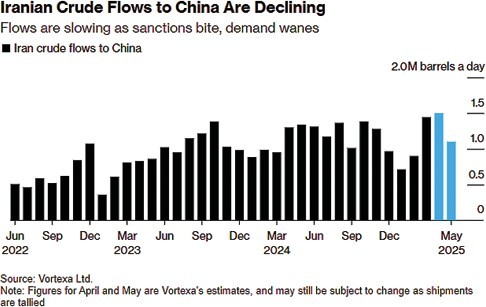
Iran’s Oil Minister, Rostam Qasemi, has said Tehran’s crude exports are unchanged from last year’s rate of 2.5 million barrels per day. But Petrologistics, a European firm that follows such matters, has reported that Iran’s visible crude oil sales fell precipitously to about 1.9 million bpd in March.
Reuters said new estimates put Iranian exports down to 1.7 million so far in April.
But Iranian efforts to hide and obfuscate make all the estimates soft and questionable.
For example, 12 million barrels of Iranian oil that were known to be in storage on board Iranian tankers in March have now disappeared from view—that is, ship tracking data doesn’t show those tankers anymore. The tankers might been re-routed to some port for delivery of the oil to some unidentified customer. Or the tankers may have unloaded their cargoes for storage on land somewhere. Or the tankers may still be floating at sea packed to the gunnels with unsold crude.
“It’s the million-dollar question—the billion-dollar question even,” a senior executive in Asia at a large oil trading house told Reuters.
One trader in Singapore told Reuters Iran has managed to sell all the crude stored on half a dozen vessels floating off Singapore a few weeks ago. The buyers were mainly Chinese and South Korean, he said. But that cannot be confirmed.
The effort to discern what Tehran is up to will get even harder in just a matter of weeks as NITC’s fleet will start to grow by almost a third. In May, NITC will take delivery of the first of 12 new supertankers being built in China. Eight are to be delivered by year’s end and the remaining four in 2013.
Iran does not yet have the capacity by itself to ship all of its exports, but when it gets the 12 new tankers it will be in a position to carry most of what it pumped and exported last year.
If Iran is using its own ships to deliver oil to customers and is paying for the freight, as some surmise, Reuters said that would reduce Iran’s revenues by nearly $5 million per voyage.
Traders say Iran is sometimes also covering insurance, which is increasingly difficult to finance on international markets. Insurance can be bought in dozens of countries—but re-insurance is done almost exclusively in the United States, long closed to Iranian cargoes, and the European Union, which will close to Iranian cargoes July 1. Faced with losing access to re-insurance, insurers are severely restricting coverage for Iranian cargoes. Insurance runs to millions of dollars per delivery.
Buyers are also demanding much better credit terms from the National Iranian Oil Co (NIOC) than normal—as long as six months to pay for each cargo of 2 million barrels. That could be worth up to $10 million per shipment. The historic norm for credit on oikl sales is 60 or 90 days.
All of that means that while Iran may be able to keep up exports of crude, its earnings will be far less than in the past, even if it sells the crude at market rates. And if the US starts announcing sanctions June 28, customers will likely start demanding deep discounts to overcome the risks they face.