

June 20, 2025
by Warren L. Nelson
Israel launched a massive missile raid on Iran shortly before dawn on Friday the 13th of June, targeting the homes of a dozen senior generals and a dozen senior nuclear scientists, the country’s largest uranium enrichment site at Natanz, plus dozens of air defense installations and locations stocking ballistic missiles.
That opened a continuing missile war in which the key question is whether Iran’s missile stockpile will outlast Israel’s anti-missile stockpile.
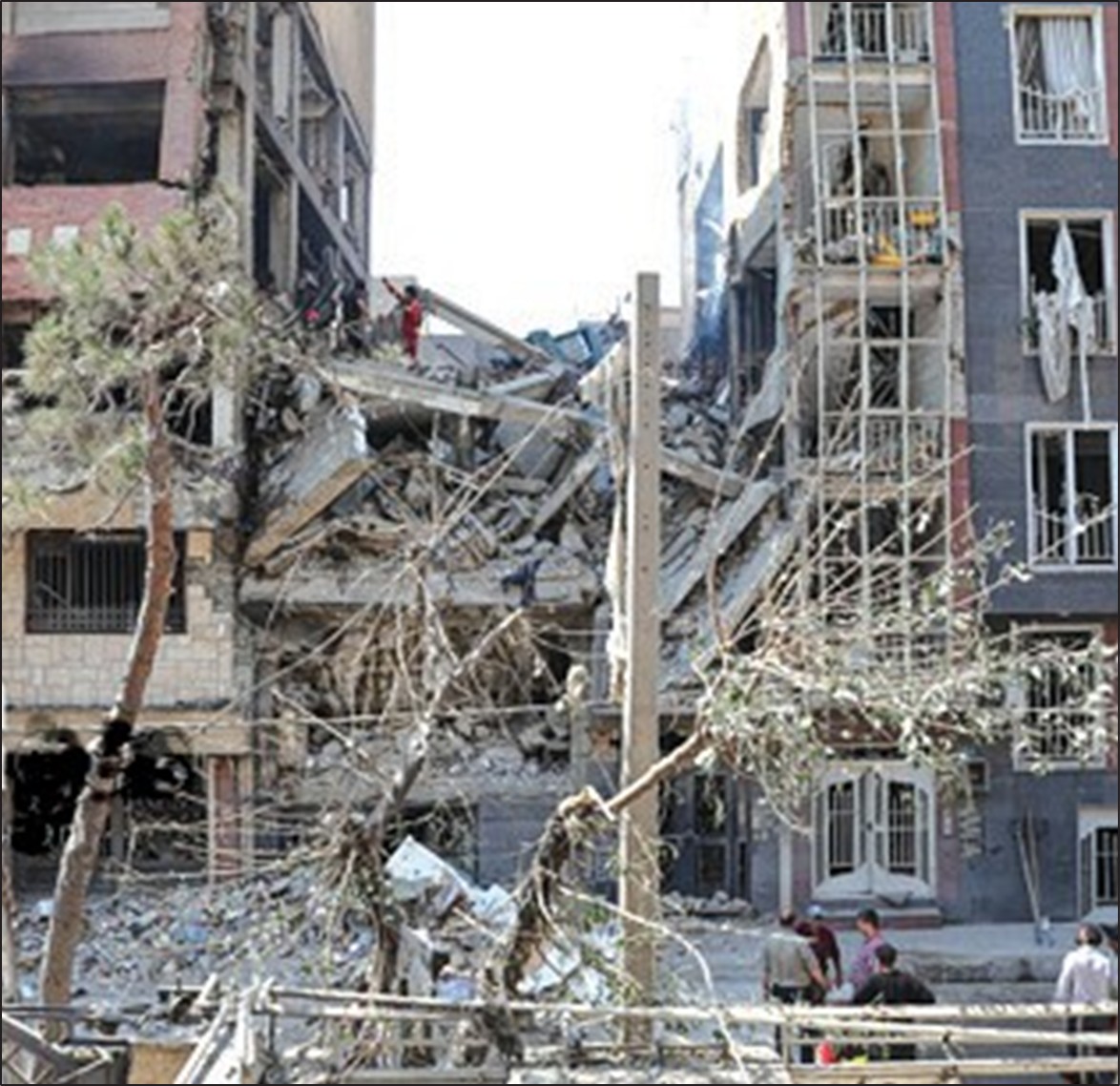
civilians even though it is targeting Pasdar generals
and nuclear scientists. At left is one pinpoint attack,
where an Israeli missile punched a hole in a
bedroom wall and exploded in flames inside one
apartment, leaving burn marks where flames shot
out the window. In the right photo, an Israeli missile did much more damage, bringing down an entire
building to get one man. One missile should not
have done this much damage, leading to speculation
the building may have been very poorly engineered.
No one knows. But the world may soon find out.
As of one week into the war, Iran has severely reduced the number of missiles it is firing daily at Iran. (See chart on Page 10.) This suggests the Islamic Republic could be staring at the bottom of its stockpile. Meanwhile, news reports from Israel say the government there is worried that its supply of anti-mis siles is dwindling rapidly.
No one knows how many missiles capable of reaching Israel were in Iran’s stocks when the war started. Numbers varying from 1,000 to 3,000 have been published. In the first eight days of the war, Israel says Iran fired 470 missiles at Israel with 43 of them impacting. That means 92 percent did not get through, a similar rate to the missile barrages of April and October last year. (That doesn’t mean 92 percent were shot down. Iran’s missiles have a high failure rate running around one quarter.)
But a number of Israelis have said Iran isn’t reducing the scale of its barrages because it is running out of missiles, but because it is running out of missile launchers. They say Israel has destroyed from one-third to two thirds of the launchers in the first week of the war.
Reports published in recent months in Iran said the Pasdaran had concluded that just firing a mass barrage at Israel, as it did in April and October last year, was not good enough, that instead Iran would need to fire multiple back-to-back barrages. But as the chart on Page 10 shows, Iran stopped firing large barrages after just three days.
In the opening days of the war, Israel went after the “underground missile cities” that the Pasdaran have been boasting about the past year—tunnels dug deeply into the earth where huge stocks of missiles are stored where Israel and the United States cannot reach them. But Israel has just hit the entryways to those tunnels and sealed the missiles in the underground chambers.
Iran has taken trucking missiles stored in eastern Iran, beyond Israel’s reach, to western Iran, from which they can be launched at Israel. The Israeli Air Force has been patrolling Iranian highways and has released a multitude of videos showing it blowing up missiles on moving trucks. It also has been locating missiles on launchers being readied for firing at Israel and boasts of blowing up many such sites, taking out both a missile and a launcher at the same time.
Iran had prepared dozens (if not hundreds) of launch sites in western Iran years ago. It isn’t known if Israel knew of those sites through spies in Iran or if it has sighted them through satellites.
Nine days into the war, President Trump joined it. He ordered six B-2 bombers to drop 12 conventional but gigantic “bunker-buster” bombs on the deeply buried underground enrichment hall at Fordo. Each bomb weighs in at 30,000 pounds, by far the largest bomb in the world. They dig a hole progressively deeper until finally hitting the hall itself. He also ordered submarines out in the Indian Ocean to send 30 Tomahawk cruise missiles against the Natanz enrichment center, which is underground but nowhere near as deeply buried as Fordo, and against the nuclear center outside Esfahan, where, among other things, refined uranium is converted to uranium hexafluoride gas that is pumped into centrifuges, which then spin to enrich the uranium. He also sent another B-2 to drop two bunker busters on Natanz.
Without the Esfahan conversion center, Iran has nothing to put in the centrifuges to enrich. Israel had already bombed Natanz and Esfahan, but not Fordo. It wasn’t clear if Trump ordered bombing at Natanz and Esfahan because satellite photos showed Israel hadn’t completed the job. There would be no need to bomb those two sites if Israel had already leveled them.
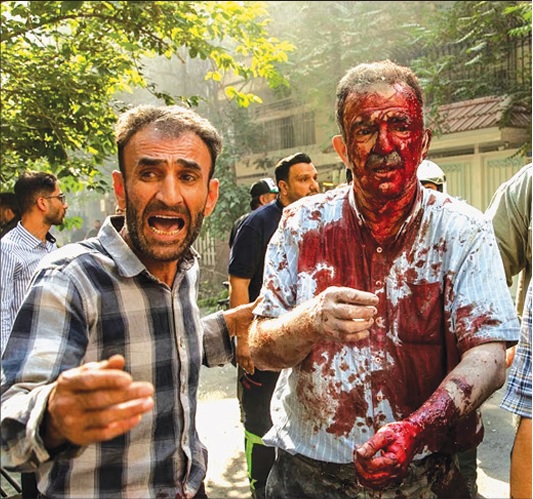
injured in Tehran and in other communities around
the country.
After the US attack, Trump went out of his way to say the US role in the war was over and finished, if Iran did not retaliate. Iran and its militias in Iraq have said they would attack US interests if the US entered the war. Trump was clearly trying to signal that he planned no further military action. If Iran or the Iraqi militias don’t understand that message and take action against the US, there will almost certainly be an expanding war.
There is also “a real concern” that Iran could activate “sleeper cells” within the US and Europe to retaliate for the US strikes, former US Secretary of State Mike Pompeo said. “These are real risks. We need to do the necessary things to protect the American people,” Pompeo said.
Pressed on what would hap pen if Iran takes steps to disrupt shipping in the Strait of Hormuz, US Vice President JD Vance said that action “would be suicidal” and would “destroy their own economy.” While much of the media predicts Iran will close the Straits of Hormuz, few specialists take that threat seriously, since blocking the straits would block every single drop of Iranian oil from being exported.
Israel had caught Iran flat footed when it attacked. The US and Iran were due to get together in Oman and talk June 15. Everyone assumed any Israeli attack wouldn’t come until June 16 at the earliest. Therefore, the Iranian military was relaxed on June 13. In the US, the White House spokeswoman announced Trump would decide “within two weeks” whether to attack Fordo. Everyone relaxed again. But less than 60 hours later, Fordo went up in smoke.
A key issue in this war, as in all wars, is casualties. Casualty figures have to be taken as estimates. The Health Ministry said that “more than” 400 people were killed in the first eight days of the war. The Human Rights Activists News Agency (HRANA) counted 722 dead in the first eight days while the Hengaw group counted 647 dead in the first seven days.
But Hengaw said only 86 of the dead were civilians while 560 were military, while HRANA said 285 were civilian, just 198 military while the other 239 were unknown.
The Health Ministry put the number of injured at 3,056 while HRANA reported a lower number, 2,546. Hengaw did not give a number for the injured.
The most stunning number came from Israel, which reported only 24 dead. All 24 came in the first three days, while no one was killed in succeeding days. The 24 include at least four Arabs. The Iranian media just ignores the issue of Israeli casualties or speaks of “many” deaths and “widespread” injuries. The Israeli government cannot falsify death figures. Israeli society will not tolerate that, considering it to be disrespectful of the dead to hide death figures.
A major issue of the conflict has been how close Iran was to possessing a usable nuclear weapon. Israeli Prime Minister Binyamin Netanyahu has justified his attack by saying Iran was on the cusp of possessing a weapon. President Trump has endorsed Netanyahu’s assertions and has denounced the official position of the US intelligence community that Iran is not currently trying to build nuclear weapons, having suspended its weapons program in 2003.
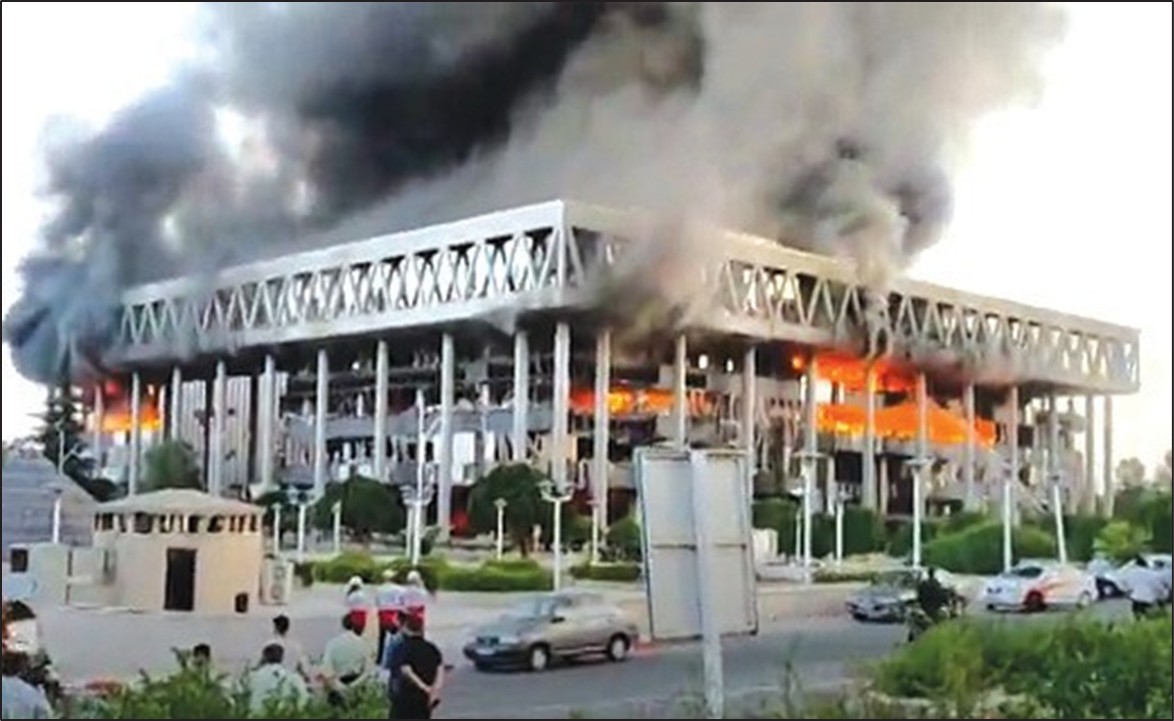
bombs on the headquarters of state broadcasting,
setting it afire.
American specialists uniformly say Iran is just weeks away from having enough enriched uranium to make a bomb, once its leadership decides to enrich it to that level. But enriched uranium isn’t sufficient to make a bomb. And even once a country has a bomb, it must be made small enough to fit on a missile.
Surprisingly, given this debate over time, very little attention has been given to the remarks of Israeli Foreign Minister Gideon Sa’ar, who said June 18 that the damage wreaked by Israel had already set Iran’s nuclear program back “two to three years.” He did not, however, explain how he came up with that number.
Europe has been urging the two warring parties to negotiate a ceasefire. Iran is not willing to talk to Israel, but Foreign Minister Abbas Araqchi has said repeatedly that Iran is willing to negotiate with the Americans— although only after Israel stops its attacks. Araqchi surely knows that is a non-starter. Furthermore, The New York Times has reported that Araqchi has spoken over the phone “multiple” times with Trump’s delegated negotiator, Steve Witkoff, since the war began. Araqchi denies that—but few believe him. (In the telephone calls, he is also talking directly to Witkoff, something he has said many times he would not do.)
One of the notable points of the war is that the Islamic Republic has been abandoned by its allies and left alone to face the fury of Israel. It has received verbal support from many Muslim nations and from such places as Russia, China, Cuba and Venezuela. But they aren’t offering any substantive help at all. (There is a question over whether China has flown some weapons to Iran, based on three planes that flew to Iran from China days after the war started. But no one knows what was on those planes.)
Even Hezbollah has offered only kind words. It was beaten too badly by Israel in recent months to do much. Furthermore, the Lebanese government and much of the Lebanese people are furious at Hezbollah for provoking Israeli action on Lebanese territory; Hezbollah likely sees any action against Israel as threatening its position as a political player inside Lebanon. The Iraqi militias supported by Iran have threatened to attack US bases in Iraq IF the United States enters the war. Only the Houthis in Yemen have said they will fire missiles at Israel now in support of Iran. But they have been firing missiles at Israel for many months (with only two getting through) and they have actually fired fewer missiles in the first week of the new war than they have usually done before.
In sum, the “axis of resistance” that the Islamic Republic has long financed to do its bidding isn’t doing its bidding any more.
The big difference between the two sides in this missile war is that Israel is firing missiles with small warheads but great accuracy, while Iran is firing missiles with much larger warheads but little accuracy. Israel has targeted individual apartments where Pasdar generals and nuclear scientists live and killed them one after another. (The wives and children of those men are commonly killed as well.) Iran, however, is essentially aiming at population centers in lieu of taking out valuable targets. In the first week of the war, the only truly valuable target that Iran hit in Israel was the Haifa oil refinery. A clear indication of the accuracy of Iranian missiles is that two struck the Jarina Mosque and the Saghir Mosque in Haifa on the Sabbath June 20, injuring congregants during prayer.
The Islamic Republic is not even killing people effectively. It has had to fire 17 missiles to kill each Israeli to die in the first week of the war, an appallingly abysmal ratio. If Iran does have the upper estimate of 3,000 missiles with the range to reach Israel, at that ratio it would only manage to kill 176 Israelis if it fired every missile in its arsenal.
Another big difference is that Israel has air raid shelters in every Jewish community—and on every block in densely populated areas—while Iran has no shelter program at all. Israelis are complaining about having to run to shelters multiple times every day when the warning sirens go off all over the country. Tehranis learn of an attack when they hear an explosion.
The result is that Tehranis have fled the city by the hundreds of thousands. Tehran news reports on June 21 said they were coming back, but the Iran Times went to press before it could evaluate those claims.
The Grand Bazaar had closed swiftly after the war began and most shops elsewhere in the city shut down. Many gasoline stations and bakeries put limits on how much gas and bread they would sell to a single customer.
Truckers had been on strike for a month before the war began, limiting delivery of goods. But they went back to work immediately after the Israelis attacked. The truckers complained that few people were working in the distribution centers they delivered to and demanded that the government see that the centers were fully staffed.
Banks were understaffed and overwhelmed by withdrawals. Many have imposed a withdrawal limit of 10 million rials ($11). ATMs are often empty. Public transportation is not operating on all routes or as frequently as normal. HRANA said the prices of essential goods “doubled” on average in the first week of the war.
The war is not evenly distributed around the country, although one report says 21 of the 31 provinces have been hit. But the war is overwhelmingly focused on Tehran—and within Tehran it is overwhelmingly focused on the northern half of the city. If you draw a line east-west through the city, with the line going through Mehrabad Airport, only two attacks in the first week were south of that line. And the farther north you go, the more concentrated the attacks. The war, in other words, is focused on the upper and middle class neighborhoods.
The regime is frightened by the prospect of opposition sparked by the war. According to HRANA, the authorities arrested at least 206 people in the first six days for criticisms posted online. These are not necessarily calls for an uprising. Many, perhaps most, are just criticisms of the regime’s conduct and policies—for example, over the absence of air raid shelters.
Many in the West are hoping that the war will prompt the Iranian public to rise up and topple the regime. Many anticipated that would happen in the 1980s in response to the war with Iraq. But Ayatollah Khomeini used that war to mobilize nationalist sentiment, recruiting many Iranians to support the war effort even though they disliked the regime.
More Iranians dislike the regime now. But plenty view Israel as at war with Iran, not with the Islamic Republic. Israeli Prime Minister Netanyahu recorded a two-minute English language video addressed to the Iranian people, urging them to rise and topple the Islamic Republic. He said the Israeli people had no argument with the Iranian people but a big argument with the rulers of Iran. “As we achieve our objectives, we’re also clearing the path for you to achieve your objective, which is freedom,” he said. “The time has come for you to unite around your flag and your historic legacy by standing up for your freedom from an evil and oppressive regime. [Tehran] has never been weaker. This is your opportunity to stand up and let your voices be heard.” There was no sign of any uprising.
A near-total internet black out began in Iran on Wednesday evening, six days into the war, essentially preventing Iranians from communicating with the outside world.
Connectivity to the global internet dropped to about 3 per cent in Iran at around 5:30 p.m. local time, according to data from the Internet Outage Detection and Analysis project at the Georgia Institute of Technology, which monitors internet outages worldwide.
The Telecommunications Ministry acknowledged that it had ordered the shutdown, saying it was done for the good of the public. There were reports saying the Israelis were using social media to track the whereabouts of people and target them. The government spokeswoman said, “For the safety of citizens, we were forced to restrict the global internet.” More likely, however, the goal was to stop people from trying to organize anti-regime protests over social media. The shutdown also stopped people from accessing foreign news sources that contradicted what the regime was saying about its great successes in humiliating Israel.
The war began with Israeli planes firing missiles from Iraqi airspace into Iran about 3 a.m. on Friday the 13th.
The Fars news agency reported that Iran’s military quickly launched a retaliatory attack by about 100 drones (not missiles). Jordan announced it shot down an unspecified number of drones flying over its territory. Israel said not a single drone hit inside Israel. Hours later, Iran denied that it had yet fired any drones at Israel, despite what Jordan said. But Iran then launched a barrage of ballistic missiles at Israel. The United States said it was helping Israel locate and shoot down incoming missiles, using both land based air defense units— THAAD and Patriot—inside Israel and at least one destroyer sailing off Israel’s coast.
In succeeding days, both countries continued missile bar rages. Iran aimed mainly at Israel’s largest population center, Tel Aviv and its environs, in part because its missiles aren’t accurate enough to hit point targets. But even when aiming at a densely populated city, inaccurate missiles usually will fall in open areas. After two days of attacks and more than 180 missiles fired at Israel, only three Israelis had been killed, all while hunkering down in their homes and all living in Tel Aviv’s suburbs.
Israel targeted: 1) nuclear industrial centers; 2) missile storage sites; 3) the homes of individual Pasdar generals (not Army generals) and nuclear scientists; and 4) assorted other military sites. After less than two days, it claimed that it had eliminated Iran’s air defense system and was free to fly wherever it wanted over Iran. However, its planes don’t have the range to fly far into Iran. Israel appears to have struck hard at air defense sites along Iran’s western border so that it can now fly as far as Tehran into Iran and then fire missiles at targets deeper into Iran.
At the end of the first week, Israel started attacking police buildings, which some suspected was part of an effort to degrade the regime’s ability to control and harass the public—and thus encourage Iranians to rise up against the regime.
The surprise was that Israel targeted individuals it saw as posing a threat to Israel—but only military and nuclear people. Israel did not target any clerical or political leaders. The palace where Supreme Leader Ali Khamenehi lives was not on the target list.
Khamenehi did not stay in his palace, however. He is presumably moving around and sleeping in a different location each night. He is clearly concerned about being killed. The New York Times said he has nominated three senior clerics from which he wants the Assembly of Experts—the body that chooses a Supreme Leader when the post falls vacant—to elect his heir. The nominees were not named, but The New York Times said Khamenehi’s son, Mojtaba, is not among them.
In military terms, the competing missile barrages have clearly come out in Israel’s favor—though the fact that Iran could even fire an answering barrage meant that Israel did not have a total military victory. None of Iran’s three attacks—last year and this month—have achieved anything militarily except to expose Iran’s military weaknesses. In human casualties, Iran managed to seriously injure a young Druze pre-teen in its first attack and to kill one Arab who was hit by falling debris in the second attack—not an impressive showing against Israel’s success in killing 11 Pasdar generals and about a dozen nuclear scientists since June 13.
In Iran, the media emphasized the damage done in the civilian neighborhoods of Tehran and painted the attack as aimed at killing Iranians. It showed major pictures of damage to apartment houses and private property, but not to military or nuclear sites, although videos posted to social media showed massive clouds of black smoke rising from a dozen spots inside the Natanz nuclear complex.
Satellite photos showed many buildings leveled at Natanz. But it was unknown what damage, if any, was done to the underground hall where about 14,000 centrifuges were operating. The Natanz hall is buried just a few dozen meters below the surface. The other enrichment site, within a mountain at Fordo, contains only about 3,000 centrifuges but is buried much, much deeper so it cannot be reached by the munitions Israel is understood to possess.
There was no attack on the Bushehr nuclear power plant, but that is not a military site, and military specialists say Israel wouldn’t waste its ordnance on such a site.
The six main generals killed were: Mohammad Baqeri, the senior-most officer in the military as chief of the general staff; Hossein Salami, the commander of the Pasdaran; Gholam-Ali Rashid, the deputy chief of the Joint Staff who is the operational commander of combat units; Amir-Ali Hajizadeh, the commander of the Pasdaran’s Aerospace Force, which designs, builds and operates its missile forces; Gholam-Reza Mehrabi, the deputy chief of the Joint Staff for intelligence, and Mehdi Rabbani, the deputy chief of the Joint Staff for operations. The first three were two-star generals; the last three were one-stars.
The Israelis also attacked the home of Ali Shamkhani, who is retired from the military. He used to command the Navy and for a decade was the staff director of the Supreme National Security Council. He survived the attack but remained hospitalized a week after the attack. Brig. Gen. Esmail Qaani, commander of the Qods Force, the Pasdar branch that operates in foreign countries, was also attacked but survived, though the extent of his injuries is so far unknown.
Israel does not have missiles of enough range to reach Iran and has not tried to build such missiles. Instead, Israel has built shorter range missiles that it can launch from its aircraft. The Israeli planes are not believed to have entered Iranian airspace in the April and October attacks last year. They flew from Israel over Syria and into Iraq, launching their missiles from over eastern Iraq. Neither Syria or Iraq possesses a modern air defense system.
But this month, Israeli jets have been flying over Iran since Iran’s air defense has been knocked out. To get that extra range, Israel has aerial tankers loitering over Syria and/or Iraq to refuel the combat jets. Iran has said very little about that. Neither country has the capability to do anything to stop that.
The Islamic Republic, however, has boasted that it has shot down four US-made F-35 jets and captured one male and one female pilot. Israel says that is nonsense and all its planes have returned from their attacks. Iran produced a video it claims showed a downed plane. But those photos are actually products of artificial intelligence.
The planes Israel used are all American-designed and -built; the missiles it used are mostly Israeli-designed and -built.
In Tehran, Brig. Gen. Ahmad Vahidi, an advisor to the Pasdar commander (and interior minister under President Ebrahim Raisi), did not say how many missiles Iran fired but reported that 150 targets had been successfully hit in Israel, including the Nevatim, Tel Nof and Ovda Air Bases. He said nothing about targeting civilian areas, but claimed that Israel’s Defense Ministry (which is visibly un damaged) and unnamed “military-industrial centers” had been hit. Vahidi called it “a major blow, which can be repeated.”
Israeli TV showed images of damaged multistory buildings in central Tel Aviv, the southern suburb of Rishon LeZion and the eastern suburb of Ramat Gan.
If Iran targeted Israel’s nuclear center at Dimona, no missiles got through. There were also no reports about missiles around Israeli air bases, which were major targets last year. It appeared the Islamic Republic had only targeted Israel’s largest civilian population center that first day.
Defense Minister Israel Katz said Iran “crossed a red line” by firing missiles at populated areas. He warned that “the ayatollah regime will pay a very heavy price” for its actions. He ignored the fact that, while Israel targeted generals and nuclear scientists, it did so at their homes, which were in civilian areas, and therefore threatened innocent bystanders in large numbers.
Rafael Grossi, the head of the IAEA, told the UN Security Council Friday that Israel’s strike on Natanz had “destroyed” the very small above-ground enrichment plant, causing chemical and radiological contamination. The underground halls were not hit, Grossi said, though damage to the power supply to the halls may have damaged the centrifuges housed there. He said the sudden power failure might have made all the centrifuges unusable.
Finally, Reuters reported that it had seen a State Department cable June 20 that said “hundreds” of Iranian-American dual citizens had left Iran over land borders in the week after the war began. One family reportedly told the State Department that two of its members had been detained as they tried to leave Iran. The cable said that the US embassy in Turkmenistan was still trying to get 100 dual nationals caught at the border into Turkmenistan, but the government there had not yet given approval.
The US does not have a diplomatic presence in Iran. Switzerland, who assists US citizens in Iran, has closed its protecting power office, staffed only by Swiss, until further notice.
“The Department has opened a crisis intake form for US citizens in Iran to pass information about consular assistance. However, because of the limitations on consular support in Iran, we do not anticipate offering direct US government assisted departure from Iran,” the Sunday guidance states.
It also advises that US-Iranian dual citizens “must exit Iran on Iranian passports and should be prepared to encounter check points and questioning from Iranian authorities before departing Iran.”
“The Iranian government does not recognize dual nationality and will treat US-Iranian dual nationals solely as Iranian citizens,” the guidance states.
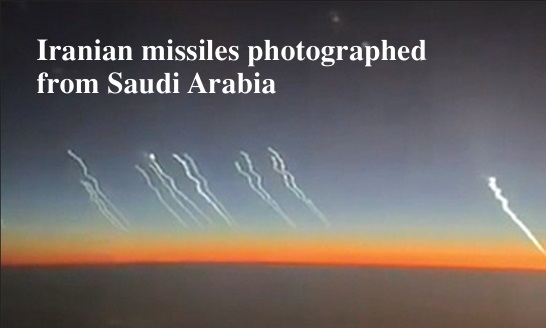
Meanwhile, Iranian-Americans trying to call their families’ cellphones in Iran since June 18 have been unable to get through. Instead, they have often gotten odd, philosophical, recorded messages, usually in English, as the government’s telecommunications system has diverted their calls. One recording goes on for 90 seconds and says, “Life is full of unexpected surprises and these surprises can sometimes bring joy while, at other times, they challenge us. The key is to discover the strength within us to overcome these challenges.”
CNN said these recordings only appeared on calls to cellphones. Landlines were not impacted.