









November 08-2013

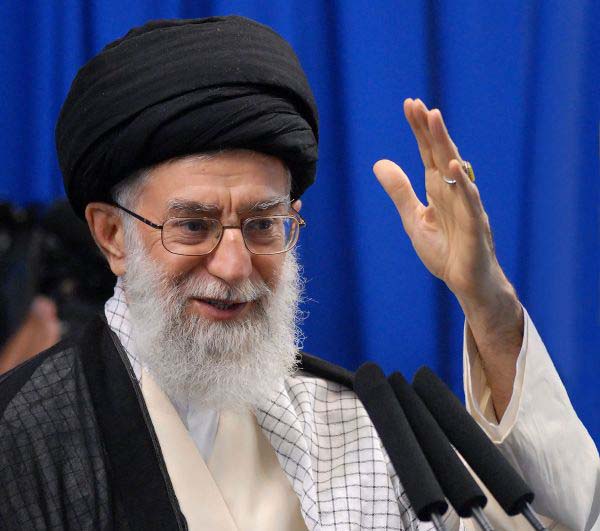
Documents leaked by Edward Snowden show that the US National Security Agency (NSA) launched an intense spying effort on Supreme Leader Ali Khamenehi when he made a provincial visit to Kurdistan in 2009.
The NSA didn’t care much about what he said. It was how he traveled that appeared to draw the intelligence agency’s attention.
Snowden, an NSA contractor who now lives in Russia, provided a stack of leaked documents to The New York Times, which published a lengthy story about them Saturday. Buried in the story were a few paragraphs about the attention it focused on Khamenehi’s trip in 2009.
The NSA almost certainly has focused its resources on other aspects of Khamenehi’s travels, but the thousands of documents Snowden shared with the Times were mainly from the period from 2007 to 2012.
In May 2009, when the NSA learned Khamenehi would travel to Kurdistan, it launched a high-tech espionage mission. This effort was just part of its continued targeting of Khamenehi in a project codenamed Operation Dreadnought.
Dreadnoughts were the giant battleships of 100 years ago, but the term is used today to indicate something that is large and powerful. That fact should puff up some egos in Tehran. However, codewords are not chosen to convey the operation underway, but to obscure them. The dreadnought as a combat ship is also old-fashioned and obsolete.
Working with the US National Geospatial-Intelligence Agency, which handles spy satellites, as well as Britain’s Government Communications Headquarters (GCHQ), the UK equivalent of the NSA, the NSA team studied the Supreme Leader’s entourage, its vehicles and its weaponry from satellites, and intercepted air traffic messages as planes and helicopters took off and landed.
The Times said it heard Khamenehi’s aides fretting about finding a crane to load an ambulance and fire truck onto trucks for the journey, presumably part of the security that goes along with the Leader wherever he travels.
The NSA studied Iranian air defense radar stations and recorded the travelers’ communications trail, including Iranian satellite coordinates collected by an NSA program called Ghosthunter.
The point was not so much to catch the Iranian leader’s words, but to gather the data for blanket eavesdropping on Iran in the event of a crisis, the Times said.
This “communications fingerprinting,” as one document called it, is a key to what the NSA does. It allows the agency’s computers to scan the stream of international communications and pluck out messages tied to the Supreme Leader. In a crisis, the ability to tap into the communications of leaders, generals and scientists might give a crucial advantage.
In Tehran, the regime appeared embarrased by the story. Foreign Ministry spokeswoman Marzieh Afkham said Iran would “launch serious investigations” and pursue all aspects of the account, “especially the political,” though it wasn’t clear what that meant, if anything.”
Documents that Snowden leaked earlier to The Guardian of Britain showed that the NSA has equipment to pick up cellphone calls at about 90 sites around the world, many of them in US embassies.
Khamenehi made a major point of that last week, saying it proved that the Iranian students were right in 1979 when they seized the US embassy and dubbed it the “Den of Spies.” Of course, the students did not accuse the US of using the embassy to pick up cellphone calls as there were no cellphones in 1979.
Since cellphone transmissions go through the ether, they can be intercepted by anyone and provide no privacy whatsoever.
The Islamic Republic’s intelligence service is known to regularly monitor cellphone calls, something Khamenehi did not mention.
The map of the spying sites did not show any monitoring sites inside Iran. But the documents said the NSA works with its sister agencies in Britain, Canada and Australia on intercepts. Neither Canada nor Britain has an embassy in Iran anymore, but Australia does. The Islamic Republic likely has developed a sudden interest in what is going on at the Australian embassy in Tehran.
Another document showed the number of cellphone intercepts under the “Cryptome” program for several countries in the Middle East for one month, January of this year. Curiously, Iran ranked very low. Afghanistan was first with 22 million intercepts in that one month, followed distantly by 12.8 million in Pakistan, 7.8 million in Iraq, 1.9 million in Egypt, 1.7 million in Iran and 1.6 million in Jordan.
Judiciary Chairman Sadeq Larijani lambasted Washington for eavesdropping on phone calls. “The Americans have violated human rights in its worst form by wiretapping conversations,” Larijani said. He asked how the Americans could criticize human rights in other countries when they were guilty of such violations.
Beyond the fact that Larijani’s complaint sidestepped the issue of the Islamic Repub-lic’s own communications monitoring, the sheer volume of numbers indicates these were not instances of listening to conversations. There are 2.6 million seconds in a month so the 22 million intercepts in Afghanistan would come to almost nine phone calls per second or 540 a minute, a number impossible to listen to. This indicates the program was looking at metadata—what phones were calling what numbers in an effort to track down the people known terrorists were in contact with. Then calls from those few phones pinpointed would be closely listened to.
The huge numbers that mean little can obscure the small numbers that are real gold mines. For example, the Snowden documents show the NSA collected 24 Internet Protocol addresses of computers being used by the Lebanese Hezbollah. NSA could thus easily read Hezbollah messages as soon as the send button was pushed and didn’t have to sift through tons of chaff.
Some of the information obtained is mated with simple police work to be effective. For example, in one case, NSA was tracking an Al-Qaeda leader traveling across Africa. Every time he checked into a new computer in a new city, the NSA picked it up. Analysts surmised where he was headed next, alerted the government there, and the police arrested the man on his arrival at the border.
Many intercepts provide cute anecdotes rather than actionable intelligence. One document said NSA listened in on Abu Mughira, a Saudi extremist, as he arrived in Afghanistan and phoned home to mom to boast of his “victorious operations.”
The Islamic Republic is one of the most important targets of US intelligence, despite the low interest by the Cryptome program. The Times reported that a 2007 document listed six “enduring targets” of the NSA: China; Iraq; Iran; North Korea; Russia; and Venezuela. The first five undoubtedly endure, though Venezuela likely has been dropped and replaced by some other country, perhaps Syria.