



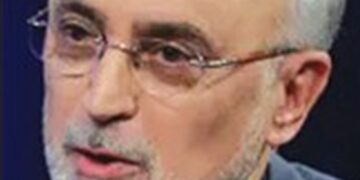








jointly but will not meet with the United States alone, Foreign Minister Ali-Akbar Salehi has announced.
The policy is nothing new, but restates clearly for the first time in a long while the decades-old fear that the Islamic Republic has of meeting alone and privately in a room with the Americans.
This is the third rail of Iranian politics. While professional diplomats and many sophisticated politicians think Iran can only benefit from negotiations with Washington, less sophisticated revolutionaries tend to fear American negotiating skills and believe that the Yanks would walk off with the Iranian family jewels if the two nations’ diplomats were ever closeted together. And anyone who actually wants to talk with Washington is swiftly tabbed a traitor.
Hence, bilateral talks have long been officially banned.
Actually, diplomats from the two countries have often met privately over the decades. It’s just not acknowledged in Tehran. Just last month, US diplomats met with Iranians at the UN mission in New York to explain the arrest of Manssor Arbabsiar and the charges of plotting to assassinate the Saudi ambassador in Washington. The State Department announced that meeting very routinely. The Foreign Ministry in Tehran was incensed and firmly denied there had ever been any such meeting; it feared once again being painted by revolutionaries as weak and soft-minded.
Salehi on Saturday firmly rejected a proposal made last week by Secretary of State Hillary Clinton for bilateral talks.
“As long as you [Americans] are not honest in your intentions, talks will be meaningless,” Salehi told reporters. “We have heard a lot of such remarks. But these statements are, unfortunately, full of contradictions. On the one hand, they voice interest [in negotiating], and on the other, they utter words that are not parallel with their primary remarks.” He was referring to Clinton’s calls for stronger sanctions on Iran.
But former Secretary of State Henry Kissinger has often characterized such talk as nonsense. He regularly explains that the whole point of diplomacy is to talk with adversaries in order to resolve contentious issues. If there is no communication, disputes just fester and grow, he says.
But Salehi did not share that view. “The time has not yet arrived [for US-Iran talks] as the Americans are unfortunately still talking boldly. We hope that the day will come when logic and rationality will prevail over US foreign policy.”
As some analysts point out, by that definition the United States would never want to talk to Iran, which continues to defend the 1979 seizure of the US embassy, to accuse the United States of state-sponsored terrorism, to comment on internal American issues like the arrests of Occupy Wall Street demonstrators, and to predict the total imminent collapse of the American government.
Iran is, however, ready and eager for more talks with the Big Six powers as a group: China, Russia, Germany, France, Britain and the United States. The talks are focused chiefly on the nuclear issue, though the Islamic Republic likes to tell its people that the talks are really to discuss global policy on everything from disarmament and Latin American development to coping with criminal gangs and drug traffickers.
Last month, Catherine Ashton, the EU foreign policy chief, wrote Iran offering to resume talks—last held with no progress in January—“in the next few weeks,”
Last week, Foreign Ministry spokesman Ramin Mehman-Parast responded: “We, too, are ready for useful dialogue and negotiation … that can deal with cooperation on common ground. The principle of the start of negotiations is an important and positive issue for Iran. We have always announced our readiness for negotiations.”
In interviews last week, Clinton repeatedly paired sanctions and the proposal for bilateral talks, continuing what has been the basic carrot-and-stick tactic pursued without success for decades by both Republican and Democratic administrations.
She told BBC Persian, “We are prepared to engage [in talks], if there is willingness on the other side. And we use sanctions … to try to create enough pressure on the regime that they do have to think differently about what they are doing.”
She told the VOA: “We’ve tried to engage and have not yet been successful. So, we’re looking at different sanctions. But we also continue to invite the regime to negotiate.”