









January 24-2014
 By Michael Doran and Max Bootjan
A great deal of diplomatic attention over the next few months will be focused on whether the temporary nuclear deal with Iran can be transformed into a full-blown accord. President Obama has staked the success of his foreign policy on this bold gamble. But discussion about the nuclear deal has diverted attention from an even riskier bet that Obama has placed: the idea that Iran can become a cooperative partner in regional security.
Although they won’t say so publicly, Mr. Obama and Secretary of State John Kerry surely dream of a “Nixon to China” masterstroke. They are quietly pursuing a strategic realignment that, they believe, will end decades of semi-open warfare between Iran and the United States and their respective allies. In our view, the Obama administration wants to see in its place a “concert” of great powers — Russia, America, the European nations and Iran — working together to stabilize the Middle East as in the 19th century, when the “Concert of Europe” worked together to stabilize that Continent.
As a first step, Mr. Kerry has made no secret of his desire to involve Iran in Syrian peace talks, scheduled to convene next week in Geneva. And much more than previous administrations, this one has refrained from countering Iranian machinations in Iraq, Syria and Lebanon.
There are two main reasons for this attempted shift. One is simply the desire of the president to extricate the United States from the Middle East. The other reason, arguably more important, is fear of Al Qaeda: The White House undoubtedly sees Iran and its Shiite allies as potential partners in the fight against Sunni jihadism.
The Obama strategy is breathtakingly ambitious. It is also destined to fail.
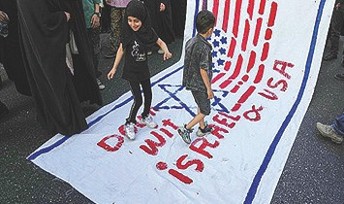
First, it ignores the obvious fact that, unlike China at the time of President Richard M. Nixon’s diplomacy in the 1970s, Iran does not share a common enemy that would force it to unite with America. Though Iran’s proxies are fighting Sunni extremists in a number of theaters, Iran itself has cooperated with Al Qaeda and other Sunni extremists, such as Hamas and the Taliban, when it has served its interests to do so. Iran’s rulers simply do not regard Al Qaeda as an existential threat on a par with the “Great Satan” (as they see the United States). By contrast, Mao did see the Soviet Union as a sufficient threat to justify an alliance with the “capitalist imperialists” in Washington.
The second major problem is that Iran has always harbored dreams of regional hegemony. There is no sign that the election of the “moderate” cleric Hassan Rouhani as president has changed anything.
On the contrary, Iran is stepping up its support for militants in the region. There have been reports recently that Iran is smuggling sophisticated long-range missiles to Hezbollah via Syria and that it sent a ship, intercepted by the Bahraini authorities, loaded with armaments intended for Shiite opponents of the Sunni government in Bahrain.
Iran under President Rouhani has done nothing to lessen its support for the regime of Bashar al-Assad in Syria either. It has, in fact, gone “all in,” sending large numbers of its own operatives and its Hezbollah allies, along with copious munitions, to help the regime stay in power.
Iran’s power play is engendering a violent pushback from Sunnis increasingly radicalized in the process. This is the third and final problem that will doom Obama’s outreach to Tehran.
In Iraq, the Shiite prime minister, Nuri Kamal al-Maliki, who is surrounded by aides with ties to the Iranians, has been arresting prominent Sunnis in Anbar Province, thereby driving many of the tribal fighters who once fought Al Qaeda in Iraq back into an alliance with the terrorist group. Al Qaeda-linked fighters have now taken control of Falluja, a town that American forces secured in 2004 after a costly campaign.
Jihadist influence now extends from western Iraq into neighboring Syria, where Sunnis are reacting just as violently to the Iranian-orchestrated offensive to keep Assad’s Alawite regime in power. With the United States providing little or no support to moderate opposition elements, extremist groups such as the Nusra Front and the Islamic State of Iraq and Syria (an offshoot of Al Qaeda in Iraq) are increasingly prominent among the rebel forces.
The spillover from Syria is also affecting Lebanon, where Hezbollah has long been the dominant force. But now Hezbollah’s ruthlessness has been matched by Sunni terrorists who, on Nov. 19, bombed the Iranian Embassy in Beirut. Hezbollah is presumed to have retaliated when Mohamad B. Chatah, a leading opponent of Syrian and Iranian interference in Lebanon, was killed by a car bomb on Dec. 27 close to the spot where a former Lebanese prime minister, Rafik Hariri, was also killed by a car bomb in 2005.
This shows what happens when the United States stands aloof and refuses to do more to counter Iranian power: America’s allies in the region take matters into their own hands. The result is the polarization of the entire region into pro- and anti-Iran blocs that feed a mushrooming cross-border civil war.
The situation will only get worse if Iran is allowed to maintain its nuclear program with international blessing. Saudi Arabia has made clear that it is prepared to build its own bomb, while Israel has threatened to launch a unilateral strike on Iranian nuclear facilities.
Mr. Obama’s hopes of using an opening to Iran to stabilize the Middle East will almost certainly backfire. Before long, America is likely to be forced back into its traditional, post-1979 role as the leader of a coalition to counter Iranian designs. The place to begin is in Syria, which is now ground zero in the struggle between the two regional blocs.
Trying to draw the Iranians into a negotiated solution will almost certainly mean keeping Mr. Assad in power. That, in turn, will only play into the hands of Sunni extremists.
The United States must work, together with its allies, to build up a non-Qaeda alternative to the Assad regime by providing moderate rebel fighters with arms, training, coordination — and, if necessary, the support of Western air power. It would have been better if we had done this at the beginning of the civil war when extremists were less prominent in the rebel camp. But even now, there is no better alternative.
Michael Doran is a senior fellow at the Saban Center for Middle East Policy at the Brookings Institution.
Max Boot is a senior fellow at the Council on Foreign Relations and the author of “Invisible Armies: An Epic History of Guerrilla Warfare From Ancient Times to the Present.”