

June 18, 2025
A massive explosion at the Shahid Rajai port on the Persian Gulf coast has killed at least 57 workers and set off an equally large explosion of fury, most of it aimed at officialdom for failure to provide adequate safety precautions.

The dead were all believed to be employees of the port. Some commentators on social media swiftly called the explosion sabotage and blamed the Israelis and/or the Americans, demanding revenge.
But the government just as swiftly denied there had been any sabotage—without even waiting for any investigation to begin. The government denied there was any sabotage while fires set off by the explosion still blazed out of control and no one could reasonably have denied any plausible cause. However, the government was anxious to kill the sabotage story because, if the public believed it, the regime would have to react and might find itself in a war.
The explosion shook the port just minutes after noon April 26 and fires continued to burn out of control for about 55 hours. Even after that, small fires erupted from the smoldering rubble periodically for a few more days.
Satellite photos showed that the damage was confined to the area of the port where containers are stacked. None of the docks was damaged or put out of operation.
Iran International said that the part of the container area reserved for containers with hazardous substances was undamaged. There was widespread speculation, however, that some one had shipped explosive material into Iran in a container that was not identified as containing explosive material.
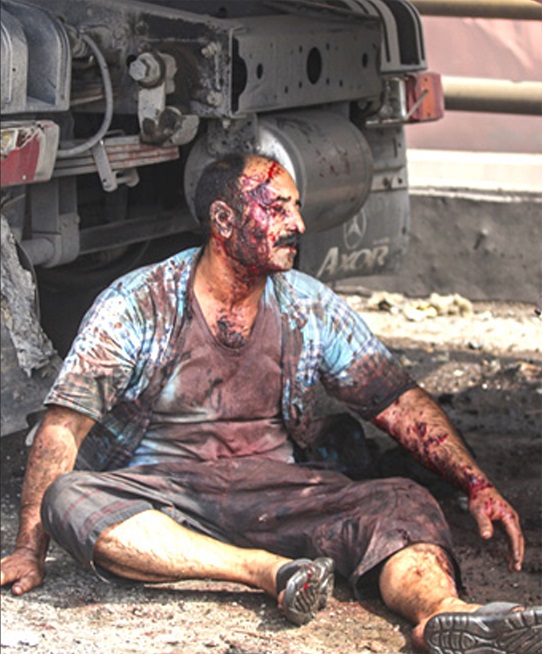
hospitalized, almost all port employees.
Many fingers were pointed at the Defense Ministry, which was reported to have brought in highly explosive chemicals with which to make solid fuel for missiles. The Israelis destroyed the plant where such solid fuel is made in their second attack last year, and news reports from China said the Chinese had sent two shiploads totaling 1,100 tons of the chemicals for that fuel that arrived in Iran just weeks before the blast. However, the Defense Ministry denied having any such chemicals stored at the port. In fact, it denied there were any military cargoes of any kind at the port.
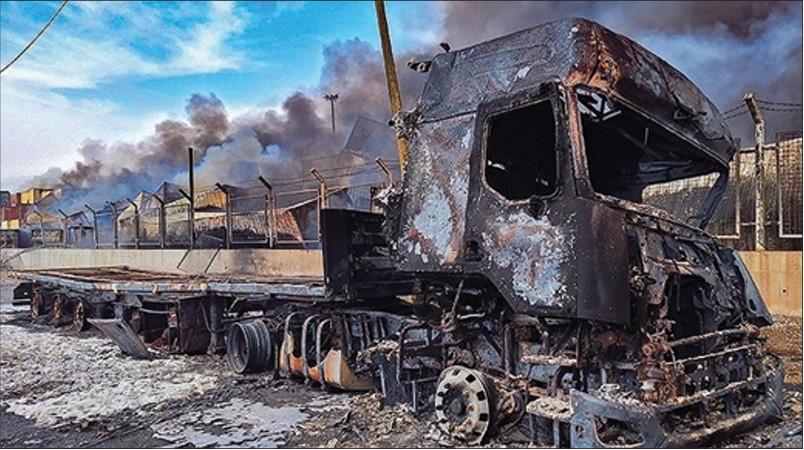
behind. It was so hot that water streams aimed at the center of the blaze
sometimes turned to steam before reaching the flames.
An investigation has been launched but no results were announced before the Iran Times went to press.
The Washington Post engaged four explosives’ experts to review videos from security cameras. They said the color of the smoke indicated that nitrate-containing compounds or perchlorates were present. The rocket fuel chemicals sent from China had been described weeks earlier as perchlorates.
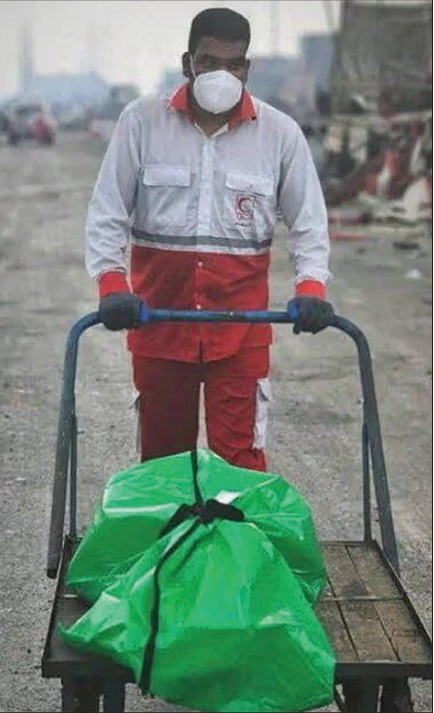
collected remains of the dead. The blast was so large
that some remains they thought came from multiple
people actually all had the same DNA.
The deadly explosion and fire reminded many in Iran of the August 19, 1978, fire at the Cinema Rex in Abadan, where 630 people died because someone locked the doors so no one without a ticket could sneak in. That tragedy infuriated the public and helped raise the intensity of anti-regime protests that ended the monarchical regime six months later.
Some suggested that the port explosion was set off by opponents of the nuclear talks with the US, which began two weeks before the blast, so the Americans could be blamed and the talks would have to stop. That would explain the speed with which the regime denied there had been any sabotage.
The shockwave from the blast was massive and was said to have been felt five kilometers away. The crater—actually two craters side by-side indicating there had actually been two explosions—were quite deep, underscoring the scale of the explosion. Satellite photo analysts could not give a depth for the craters, but said they were 104 feet and 82 feet (32 meters and 25 meters) in diameter. Explosives experts contacted by the Post estimated the size of the explosion as the equivalent of 50 tons of TNT. The largest bomb made by the United States is 11 tons of TNT. (That is the bomb the United States is expected to use on buried Iranian uranium enrichment plants, if it ever attacks them.)
It wasn’t easy to fight the fire. The chief of the Tehran Fire Department, who was called to the scene, said the temperature reached 1,400 degrees Celsius, meaning that much of the water firemen tried to spray on the flames turned to steam before it even got to the flames. He said firemen had to identify the contents of each container before working to extinguish the flames engulfing it because, for example, water cannot be used on a bitumen fire. He said firemen were trying to break into one end of a burning container to determine what was burning at the other end.
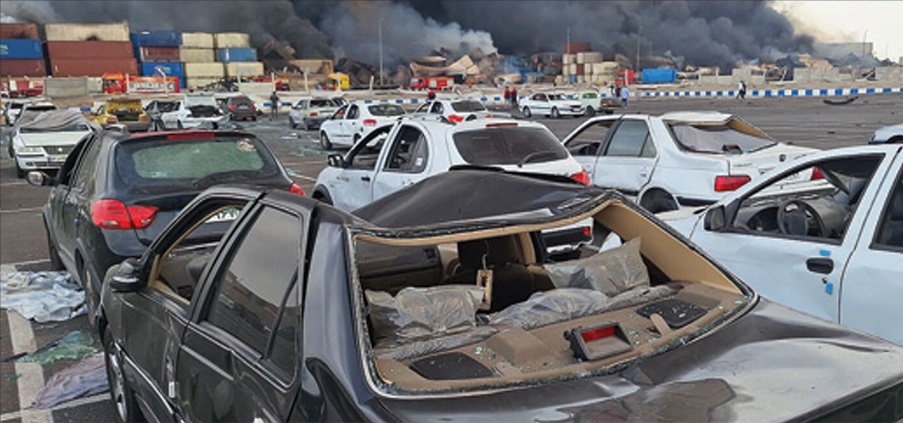
outside the port were damaged by debris that fell out of the sky.
It was a grisly task gathering the remains of the dead. For a few days, the government said the death toll was 70. Then it dropped that number to 57 when DNA testing showed that boxes of remains thought to represent, say, three people, actually all came from the same person. Forty-six of the dead were quickly identified when relatives of the missing provided DNA samples. But 11 of the bodies have not been identified, and many people suspect they were Afghan day laborers. Meanwhile, 13 families have reported their breadwinner did not come that night and there is fear those 13 might still be buried under the debris—which would take the death toll to 70.
Iranian media outlets received calls from state censors telling them not to engage in “illegal activity,” though that was not defined. Presumably, that meant not to speculate on the cause. But in the age of social media, such cautions are meaningless. The public was widely speculating, with many accusing the government of a cover-up even though there was no way to start an investigation until days after the blast because of the continuing fires.
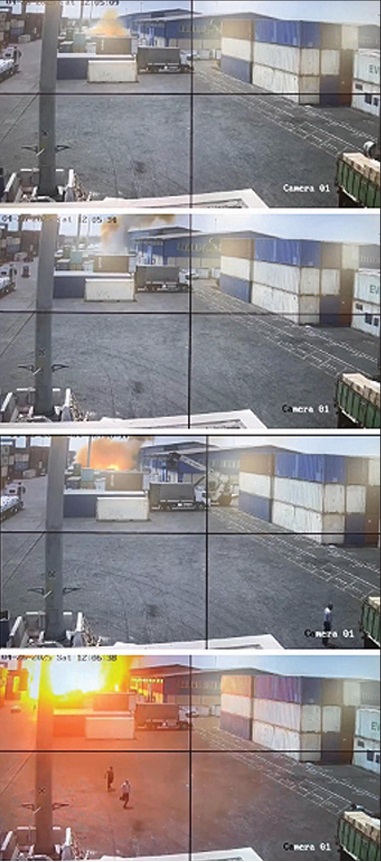
camera at the port shows a small fire becoming a
big fire and then an explosion
A total of 1,516 people were rushed to area hospitals. Many reported they were left on the floor in hallways because there were not enough beds for all the injured. IranWire quoted a customs employee who was among the injured as saying relatives of the injured were told to go out and buy medical supplies needed by their loved ones. One nurse said most of the injured suffered burn wounds. A week after the blast, the medical system said only 25 injured were still hospitalized.
Video from a security camera placed on the roof of a building in the port showed flames coming from a stacked container that no one on the ground seemed to notice right away. The first flames were visible at 12:05:08 p.m.—67 seconds later, the flames soared high above the container. Twenty-four seconds after that, a huge blast erupted, and the video stopped.
There was much speculation on the economic impact from the explosion and fire. Because the docks and loading equipment were not impacted, the port resumed operations after just two days. (Satellite photos show the container storage yard is about 1,400 meters—4,600 feet or 9/ 10ths of a mile—from the nearest dock.) So, there is likely to be little impact on import and export activities. The damage is likely to be largely confined to the businesses that had containers of consigned goods that are now rubble.
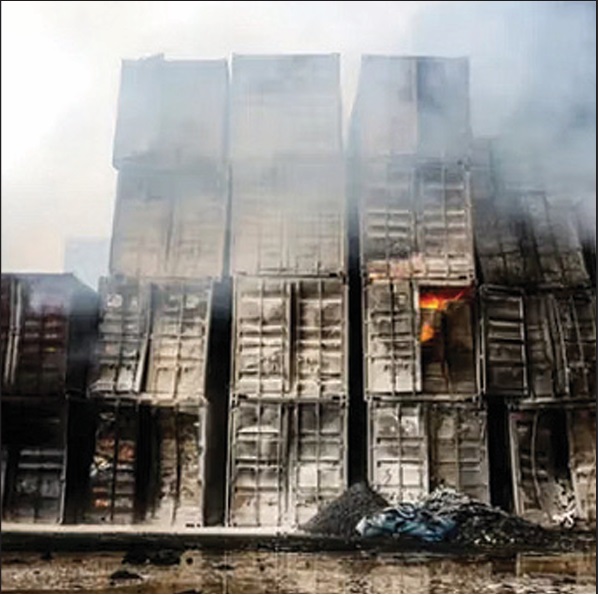
to hundreds of stacked containers.
The port itself is Iran’s largest and most important, handling 85 percent of all of Iran’s container shipments.
Another irritation for many came when Supreme Leader Ali Khamenehi declared one day of mourning for the dead. Many complained that he had declared five days of mourning for Hezbollah leader Hassan Nasrollah, a Lebanese national.
There was more anger after Interior Minister Eskander Momeni, in an apparent fit of nationalism, denied that fire fighting planes sent by Russia had been used to fight the flames. The Russian Embassy quickly released a video showing Russian aircraft flying above the port and dropping water on the fire. Two days after the explosion and before the official investigation could be started, Interior Minister Momeni told state television that “culprits have been identified and summoned.” Nothing further has been heard about these supposed “culprits.” Like Police Captain Renault in the film “Casablanca,” Iranian police “round up the usual suspects” immediately after any untoward event.