

June 20, 2025
Analysis by Warren L. Nelson
Most of the world’s news outlets reported—before the latest missile war began—that Supreme Leader Ali Khamenehi had rejected the Trump proposal for a nuclear agreement, but missed the fact that he never ordered an end to talks. Actually, all he did was regurgitate his decades-old arguments for autarky, that Iran should produce everything it needs and not deal with the rest of the world because that world is hostile and would just as soon obliterate Iran.
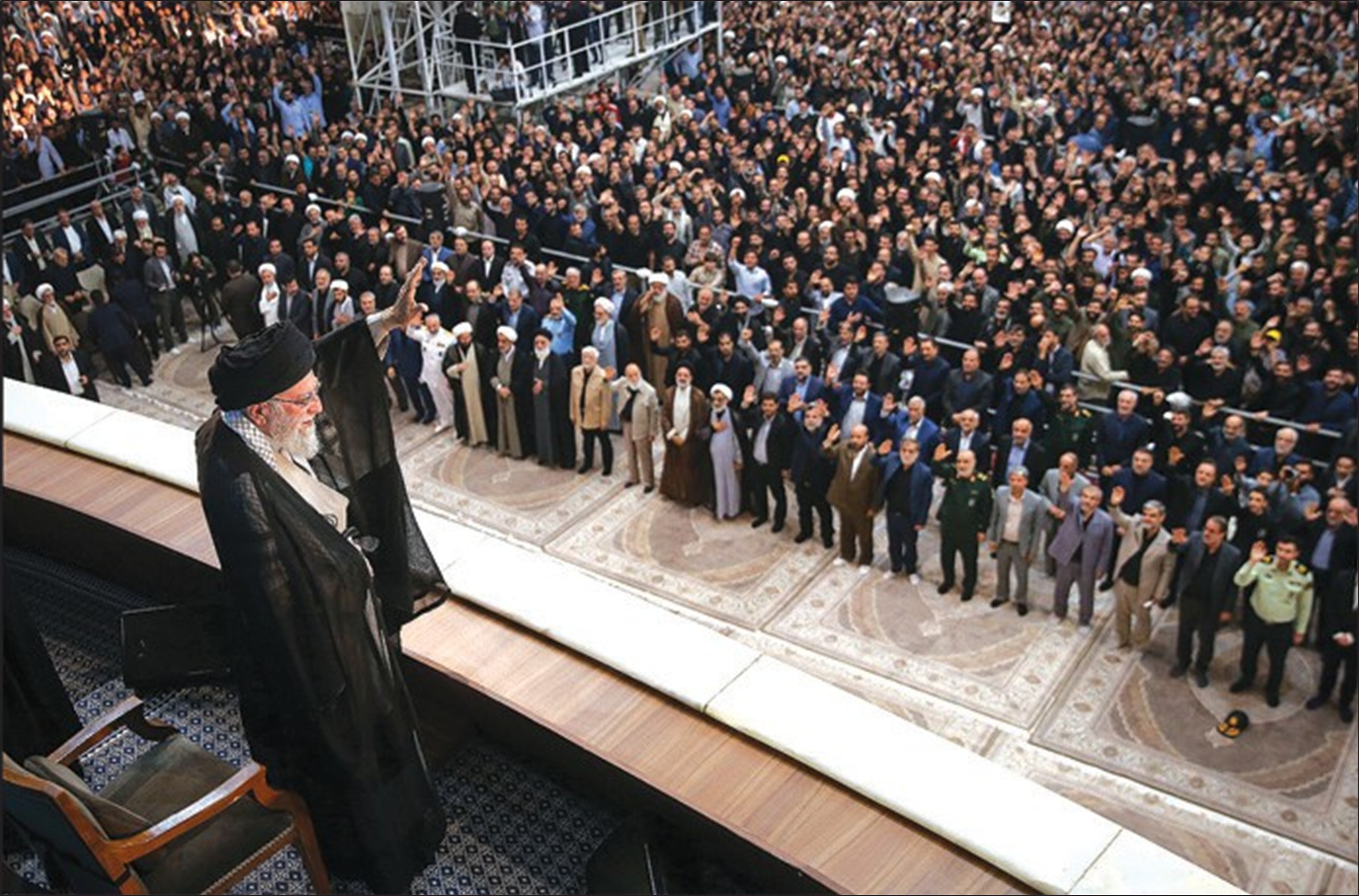
this was their last public appearance—filled the Khomeini Mausoleum to hear the
Supreme Leader speak on the 36th anniversary of the death of Ayatollah Khomeini..
Khamenehi was not making a policy declaration in his speech but just funneling a repeat of standard regime ideology arguing for autarky, an economic view long rejected by both liberals and conservatives the world over, but fully embraced by revolutionaries in Iran (and by Trumpians in the United States).
Khamenehi only briefly mentioned the Trump proposal and was clearly hostile to it. But his speech June 4 was not a policy speech of the kind he occasionally makes, in which he carefully lists points and elucidates them. This speech was just one of his standard rhetorical heaves in which he spears the West as Satan and portrays the Islamic Republic as the moral high point of the modern world.
When he makes a policy speech, Khamenehi is very clear. For example, on the very topic of a nuclear agreement with the West, Khamenehi gave a speech a decade ago in which he listed, point-by point, a dozen key components that must be included in any agreement. When the Joint Comprehensive Plan of Action (JCPOA) was published months later, it contained only three of Khamenehi’s points. But Khamenehi still endorsed it, an indication of how flexible Khamenehi can be—when he recognizes he has no choice.
It is worth noting that Khamenehi for years condemned the idea of allowing women to attend soccer games—until he reversed himself last year. And he made numerous speeches asserting that hejab was at the very foundation of the revolution—until he reversed himself last year when he was convinced by President Pezeshkian that enforcement was undermining the very authority of the regime.
In his June 4 speech, Khamenehi did not issue any orders to Iran’s nuclear negotiating team, he did not lay down any principles for an agreement with the West, he did not proclaim any policy. He just chatted about how horrible the Americans are and how they want to weaken Iran so they can dominate the country.
He did not stint on harsh rhetoric, calling American officials “rude,” “insolent” and “loudmouthed.”
Yes, he did make the point—repeatedly—that it is crucial that Iran be able to enrich uranium if it is to be recognized as a great power. But until a few months ago, he repeatedly made the point that the requirement for hejab must be enforced if Iran is to be a true Islamic state. Flexibility and realism are the hallmarks of Khamenehi’s rule, not ideology, although he bows to flexibility and realism only after long and costly battles for ideology. The bottom line is the survival of the regime, not the survival of the regime’s ideology.
It must be noted that Khamenehi’s speech came on June 4, the 36th anniversary of the death of Grand Ayatollah Ruhollah Khomeini. The speech was given to a huge crowd gathered inside the vast mausoleum built to honor Khomeini. This is the day and the place for Khamenehi to make one of his annual grand speeches of the regime’s ceremonial calendar. The speech was televised nationally.
The speech came in three parts. The first part was an encomium to the leadership of Khomeini in creating the Islamic Republic. The second part was a discussion of the need for Iran to enrich uranium to have a major impact in the world. And the third part was a screed against Israel for its brutal treatment of Gaza and against the West for doing nothing to stop Israel.
In the speech, Khamenehi yet again purloined the old Barack Obama campaign slogan, “Yes, we can.” He said the Islamic Republic had developed a full nuclear fuel cycle because its young scientists were wedded to the belief of “We can.”
“Thanks to the intelligence of its youth and the efforts of its hard-working scientists, Iran has been able to enjoy a complete nuclear fuel cycle, while there are very few countries in the world that have this capability,” Khamenehi said, making the point that the Islamic Republic has thus raised Iran to greatness in the eyes of the world.
He said the nuclear industry was not limited to the production of clean and cheap electricity. “The nuclear industry is a mother and main industry, and according to reports from experts and scientists that should be presented to the public, various fields of basic science and engineering, such as nuclear physics, energy engineering, materials engineering, as well as precise and sensitive technologies in medical equipment, aerospace, and precise electronic sensors, are dependent on or affected by the nuclear industry.” This is not really true but is a frequent theme pressed by Khamenehi. No country except Iran rates the nuclear industry as a “mother industry,” a term reserved for industries that produce the infrastructure for other industries, such as steel and energy.
He argued that mastery of nuclear science is not possible without enrichment capabilities, although most countries active in nuclear fields have no enrichment capability whatsoever. He said: “Without enrichment, we must reach out to enrichment owners to provide fuel for our power plants; like if they tell us that despite having oil, you do not have the right to build refineries and produce gasoline and that you must act on the wishes of other countries to buy and supply your gasoline.”
He then said: “Without enrichment and the ability to produce fuel, even having 100 nuclear power plants is useless; because we must reach out to the United States to provide fuel, and they may set dozens of conditions for this.” This ignores the fact that the fuel for Iran’s one existing nuclear power reactor and two power reactors under construction comes entirely from Russia. But Khamenehi’s point, constantly made over the years, is that Iran must provide for itself everything it needs and not rely on any foreigners who would most definitely squeeze Iran for their own benefit.
He also cited nuclear medicine and other applications of nuclear science. But those do not require enriched uranium.
“Our message is that Iran’s destiny is in its own hands,” Khamenehi summarized.
Autarky or self-reliance stands as the very foundation of the Islamic Republic, although it is an economic fallacy. While President Trump does not speak of autarky the way Khamenehi does, it is clear from Trump’s policies—such as bringing basic industry back to the United States—that he shares Khamenehi’s view that a country should provide for all its own basic needs.
But the economic rule that has prevailed for a century in the world is “comparative advantage,” the antithesis of autarky. Comparative advantage means that each country should produce what it can produce best and cheapest and supply to the rest of the world while it imports what other countries can produce better and cheaper.
Khamenehi’s entire view of the enrichment issue stems from the theology of autarky. In his speech, he didn’t even nod at the concern of the rest of the world—not just the United States—that Iran might build nuclear weapons if it has enrichment.
He said, “The first thing the US insists on is that Iran should not have a nuclear [enrichment] industry, so that we would be dependent on America. Our response to this US nonsense is clear: they cannot do a damn thing about it.” That last phrase is appropriate for a speech at the Khomeini mausoleum because it was what Khomeini told the Americans when Iran was holding 52 American hostages.
Khamenehi asked the West, not just the Americans, “Why are you interfering and trying to say whether Iran should have uranium enrichment or not? That’s none of your business.” That made for good rhetoric, but ignored the fact that the Islamic Republic began talking with the Europeans about Iran’s enrichment program more than two decades ago.
Khamenehi spoke one day after Trump posted on his social media platform, “Under our potential Agreement – WE WILL NOT ALLOW AN ENRICHMENT OF URANIUM!” Actually, it turned out later that the US had just proposed that Iran be allowed very limited enrichment. Trump was not actually being accurate, but was trying to appease his very anti-Iran base.
Given what Trump had posted, the international media rationally saw Khamenehi’s speech the next day as a response to Trump rather than the ideological stem-winder it actually was designed to be on one of the high points of the Islamic Republic’s calendar.
Steve Witkoff, Trump’s chief negotiator with Iran, fully understands the political significance of enrichment to the regime and has recently come to understand the political significance to the GOP base of halting enrichment (A total of 85 percent of the GOP members of the House and Senate have signed a letter to Trump demanding that any agreement halt all enrichment by Iran.) Witkoff is trying to thread a needle between those two extremes. Logically, that is not possible. But Witkoff is trying some legerdemain to make it look good enough both to the Islamic Republic and the GOP base. Iranian Foreign Minister Abbas Araqchi appears to be fully wedded to the same approach.
In news coverage by major outlets around the world, everyone recognized Khamenehi’s strong words condemning what Trump had posted the day before. But most stopped there, seeing the condemnation as a roadblock rather than mere repetition of what Khamenehi had long been saying (just as he long insisted on hejab enforcement and banning women from soccer stadiums).
It was left to The Associated Press and the Reuters news agency, the world’s two most important news outlets, to point out what Khamenehi did NOT say. In the fourth paragraph of its story, Reuters wrote that Khamenehi “said nothing about halting the talks.” The Associated Press, in its lead paragraph, said Khamenehi “criticized” the US proposal but “stopped short of entirely rejecting the idea of an agreement with Washington.”
It is always important to note what political leaders say, but also to note what they do not say.