














June 20, 2025
The Iranian government is currently carrying out one of its largest-ever expulsion campaigns targeting Afghan refugees, and appears to be driving out far more aliens than the similar Trump anti-foreigners campaign in the United States.
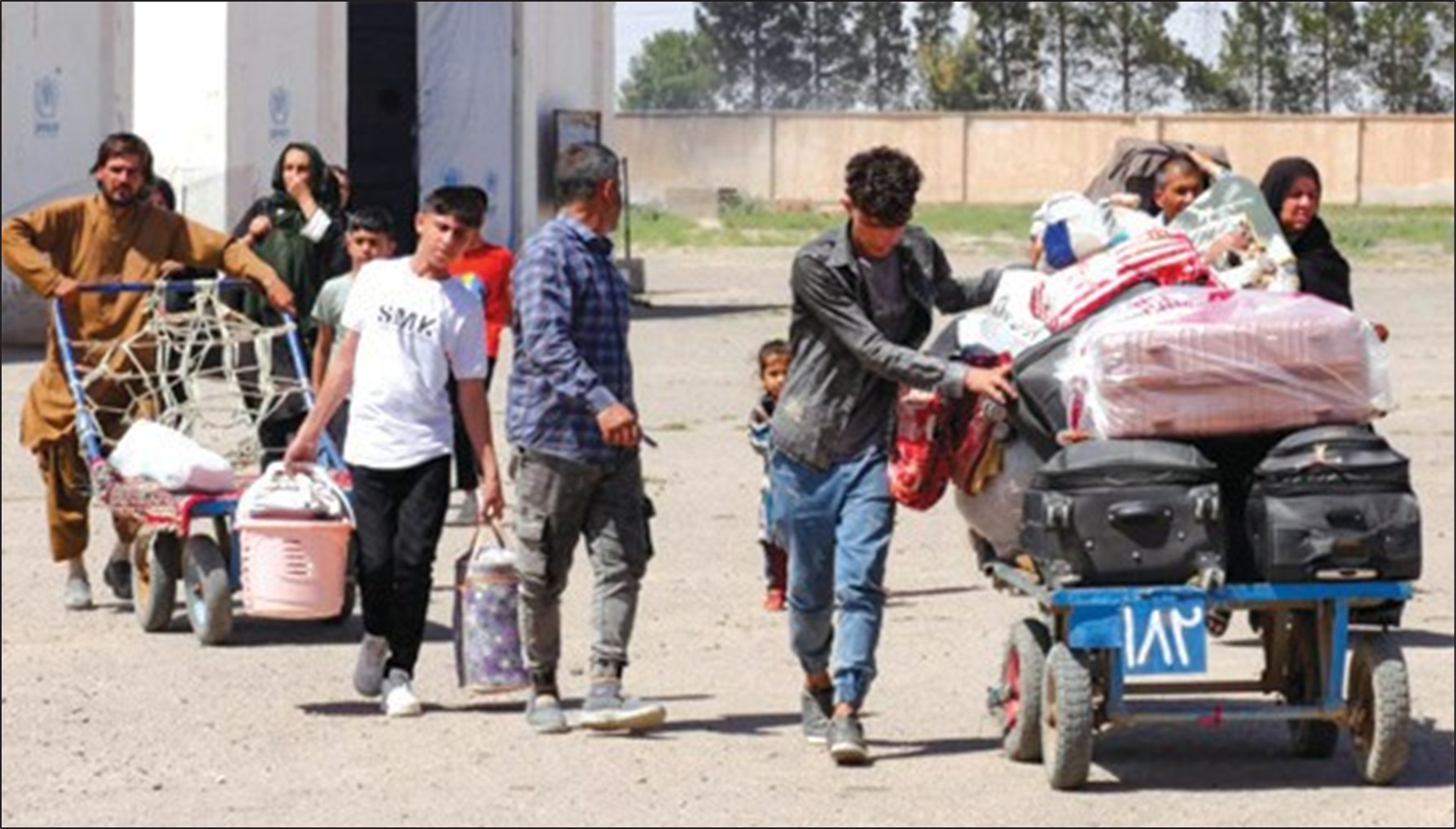
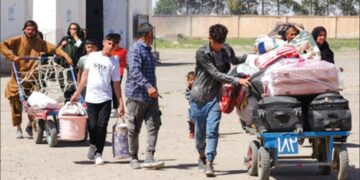
with their baggage as they leave the border post at Islam Qala in Herat Province
to find their way to shelter.
Of the estimated six million Afghans who have settled in Iran– fleeing war, political instability and economic crises – the two million who hold a temporary document granting them provisional residence are now being threatened with expulsion. The other four million are undocumented migrants who had previously been the sole target of periodic expulsion campaigns that weren’t taken too seriously and were not particularly effective.
The two million people who hold a “registration slip,” a document issued by Iranian authorities to undocumented migrants while awaiting possible regularization, were tolerated until March.
Then, an announcement from the Interior Ministry declared they would be denied access to basic services (education, healthcare, housing). The pressure quickly mounted and expulsions have begun.
At the end of May, the Interior Ministry ordered these migrants to book an appointment before June 7 to start a regularization process; after this deadline, they would be considered undocumented. All undocumented Afghans have been ordered to leave Iran by July 7.
Of the two million holders of this registration document, only six categories of people will be allowed to remain legally in the country – among them, former military personnel of the previous Afghan regime, before the Taliban takeover.
The latest expulsion campaign appears to have many more resources than previously and expellees have crowded border posts as they are dumped there by Iranian police.
One question is how many will turn around and walk back across the border into Iran in the coming months. That has been the norm in the past. Iran is building a border wall, but it is now just 100 kilometers long— and it can be defeated with a ladder.
The UN’s International Organization for Migration (IOM) has expressed alarm over the sharp rise in the number of Afghan families being deported from Iran and called for the immediate suspension of the forced return of Afghans, regardless of their immigration status.
In a report released June 3, the IOM said that Afghans deported in previous months were “predominantly” single young men, but “a new and concerning trend” emerged in May with a surge in the forced return of Afghan families.
The IOM said it recorded 15,675 families returning from Iran in May, more than double the 6,879 families who returned in April. In addition, it said the number of undocumented families returning in May 2025 was more than three times higher than in May 2024.
Many Afghans complain about being poorly treated by Iranian authorities. An Afghan man who was deported from Iran with his family in May told Radio Azadi, the US-funded broadcaster, that the authorities arrived at the farm where his family and other Afghans were working and “deported everyone from the fields all at once.”
Another Afghan national who did not want to be identified told Radio Azadi that Afghan refugees in Iran “suffer a lot.” He said, “[The authorities] mistreat families and throw them out of their homes. There are a lot of arrests and detentions. People are suffering a lot,” he said.
The spike in forced returns from Iran comes amid ongoing mass deportations from Pakistan, where thousands of Afghans also are being sent back each week.
“Combined, these pressures are overwhelming Afghanistan’s fragile reception and reintegration systems, particularly in areas of high return,” the UN agency said.
The IOM urged “all countries to immediately suspend the forced return of Afghans, regardless of their immigration status, until safe, voluntary, and dignified return conditions are in place.”