

December 06-2013

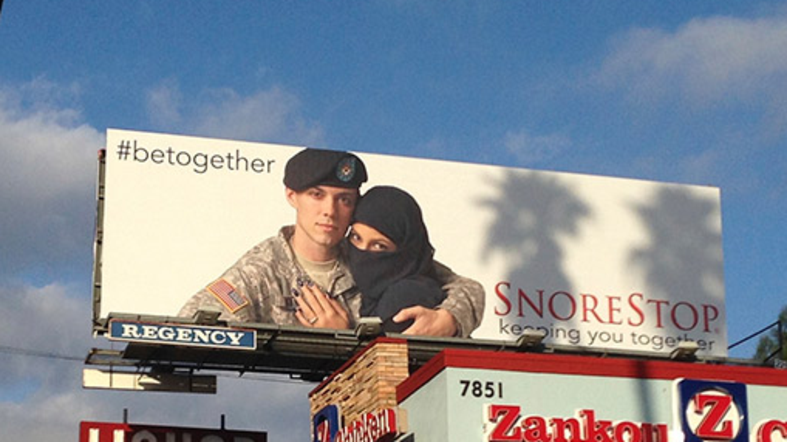
An American billboard advertising a cure for snoring and showing a Muslim woman in niqab nuzzling up against an American soldier in uniform has prompted a great deal of commentary—both pro and con.
The soldier in the photo really is a soldier and the woman is an Iranian-American, but doesn’t wear niqab or any head covering in real life.
The billboard first went up on Sunset Boulevard in Los Angeles and instantly drew attention. It is due to go up at about 20 sites elsewhere across the United States in the coming weeks—but Clear Channel, the main billboard firm in New York’s Times Square, has turned it down.
Clear Channel said it rejected the billboard “because of its sensitive nature and uncomfortable imagery.”
The billboard is an ad for SnoreStop—pills and sprays designed to stop snoring and make sleeping a more peaceful experience for wives, whether they wear niqab or not.


Melody Devemark, spokesperson for California-based SnoreStop, said the overt notion behind the billboard is that their product can help even the most unlikely couples stay together. But beyond that, the concept being pushed is tolerance.
“It’s about acceptance and inclusion of all couples,” Devemark said. “Whether it’s race, gender, ethnicity or religion.”
Devemark said reaction has been strong, both positive and negative.
A YouTube video explains the concept behind the billboard and interviews the models.__The soldier, Paul Evans, is from Alabama and had some family frictions when he dated an African-American girl as a teenager. He said, “I did this [ad] because I am no stranger to other people’s discrimination.” The woman is Lexy Panterra, a singer and actress whose father is Iranian.
In addition to Times Square, some other billboard companies have refused to carry the ad.
Dr. Hind Jarrah of The Texas Muslim Women’s Foundation said the ad perpetuates stereotypes instead of defying them. “The ad definitely is shocking and makes me think, but all the thoughts that it generates are negative, no matter how I try to look for positive nuances in them,” she told Channel 8 in Dallas, where the billboard is due to go up shortly.
Jarrah went on to express concerns that the couple’s married relationship is merely implied; the woman’s hand bears a wedding ring. She said some might see the picture as an expression of an American soldier exercising control over a Muslim woman.
Alia Salem of the Council on American-Islamic Relations (CAIR) disagreed. ”We’re always in support of anything that promotes dialogue of race, religion, things like that. Things that get people talking,” she said. “And the juxtaposition of these particular people was something that got a lot of conversations started, and I do hope for that in the future.”