









December 20-2013
 This is the second of three parts.
By Jahangir Amuzegar
President Ahmadi-nejad specifically promised to fight the “oil mafia,” put oil money on everyone’s dinner table, restore full employment within two years, and reduce the size of government.
A confessed economic illiterate and proud of it, he once said, “Thank God that I do not know about economics.” He embarked on a number of misguided policies, ignoring all advice from independent economists and relying on his personal and ideological tendencies. Influenced perhaps by his austere childhood and regarding money as the key to every economic problem, he began with a highly expansionary program: increasing the fiscal budget, revving up the Central Bank’s printing press, expanding bank lending, and removing every administrative barrier to his plans. He dismissed several Central Bank governors who abstained from monetizing the government’s debt. According to a newspaper report, some 500 trillion rials were printed and put into circulation during Ahmadinejad’s tenure. At the same time, the government debt to the banks and the private sector during his tenure reached 1,800 trillion rials ($72 billion). The annual budget went up 5 percent above the inflation rate, from 1,590,000 billion rials in 2005 to 7,280,000 billion in 2013—4.5 times—with a deficit every year. Corresponding total liquidity in-Iran’s non-oil trade balance; and (e) giving creased from 92,000 billion rials to 5,300 billion – 5.75 times. During the same period, the state sector’s debt to the banking system went up from 236 trillion rials to 1152 trillion. A fortuitous rise in oil-export receipts gave his administration some $700 billion – compared to $440 billion received by all previous administrations since the revolution, and five times the receipts between the discovery of oil in 1906 and the end of the Pahlavi regime in 1979.
Faced with protracted double-digit price rises from perennial budget deficits and rising debt to the banking system, Ahmadinejad decided to combat this demandcaused economic disequilibrium by focusing on the supply side. Thus, instead of trying to raise revenues or reduce wasteful expenditures, he chose a crowd-pleasing, short-term policy of controlling costs, with scant regard for its harmful long-term implications. To keep household and business expenses in check, the government proceeded to hold three vital cost factors -exchange rates, interest rates and basic energy prices – in check through government diktats. The outcome was a near disaster in all three areas.
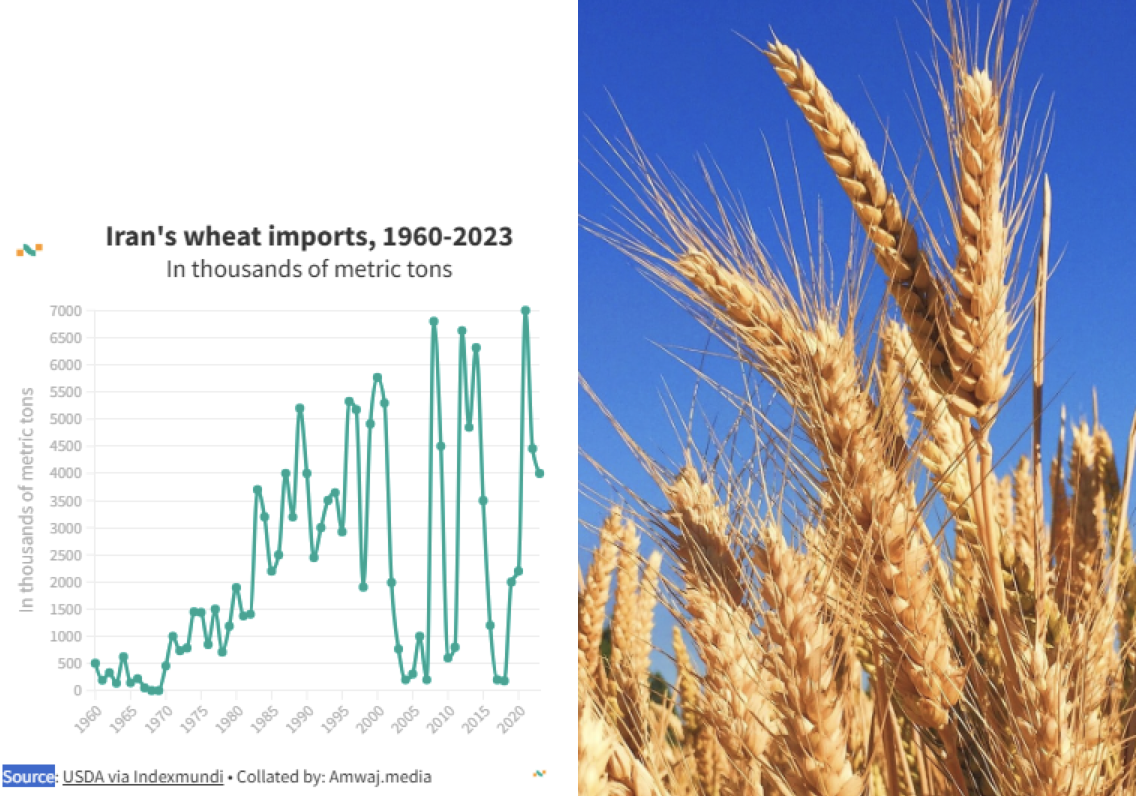
Regarding a strong national currency as a symbol of affluence and prestige, the president pushed to keep the Iranian rial artificially high against the U.S. dollar and other foreign exchange when every economic indicator required the opposite policy. Keeping the exchange rate artifi- cially overvalued in order to hold import costs down led to a number of troublesome consequences: (a) reducing domestic producers’ ability to compete with foreign suppliers; (b) bringing down domestic production capacity of import-competing industries by some 30-40 percent; (c) idling thousands of workers with each additional $128 billion of imports; (d) worsening Iran’s non-oil trade balance; and (e) giving a hefty subsidy to foreign farmers and manufacturers. The over-valued exchange rate also resulted in increased national dependence on the world economy (even for essential food items) and capital flight.
Thus, with the imposition of tough new sanctions on Iran’s oil exports and its central bank operations, announced in late 2011, the Iranian rial lost two-thirds of its value against the dollar and other foreign exchanges. The subsequent era of exchange instability was ensured. Strangely enough, toward the end of his tenure, when the U.S. dollar value of the Iranian rial was fixed by the central bank at around 10,000 rials and the inflation-adjusted equilibrium rate was estimated to be 24,000 rials, the president wished to bring the rate down to 5,000 rials.
The government’s extensive interestrate regulation and mandatory lending was the second policy mistake. Holding interest rates on savings deposits below the inflation rate and keeping bank charges on commercial and investment loans below free-market levels in the bazaar inflicted immeasurable damage to the economy.
Low (and negative) returns on deposits discouraged individual savings, stifled productive investments, and led savers to move their funds from bank accounts to such outlets as real estate, precious metals and U.S. dollars. Losing savings deposits led the commercial banks to steadily borrow from the Central Bank for their voluntary as well as state-mandated loans.
As a result, commercial bank debt to the Central Bank rose more than 13 times. Government-dictated loans to favored, but money-losing, projects have been a main cause of the banks’ skyrocketing nonperforming assets -from a mere 70 trillion rials in 2005 to 700 trillion rials in 2013. Sizeable differences between mandated bank interest rates and the rates prevailing in the bazaar, combined with the small penalty for late repayments of loans, induced some well-connected businessmen to borrow money from the state banks at rates in the low 20s, lend the borrowed sum in the bazaar at percent rates in the 30s, and postpone repayment of the loans for years at an annual penalty of only 6 percent! Poor and unprofessional assessments of borrowers’ proposed projects and the concentration of bank loans on a few selected megaborrowers were other causes of the banking system’s problems.
Nearly 8 percent of total bank loans are now reportedly in the hands of less than 12 percent of active businessmen.
Keeping energy prices artificially down for years resulted in profligate energy consumption, the continuation of energy inefficiencies, the rise of energy intensive industries vulnerable to external shocks, and a growing need for energy imports, severe air pollution and a clear rise in energy smuggling to neighboring countries.
The outcome of this rank mismanagement has been well reflected in the behavior of the main economic indicators. The GDP growth of 6.9 percent in 2005 gradually tapered off year after year, ending the last two years of Ahmadinejad administration (2011 and 2012) in negative territory, at minus 1.7 percent and minus 5.4 percent, respectively, for an average annual growth of 3 percent during the whole period.
Even this modest growth was achieved at a very high cost. For each 1 percent of growth during the Khatami administration, the government had invested $5.4 billion, while the Ahmadinejad administration spent $8.2 billion.
Data on various aspects of employment (and unemployment) are among the least comprehensive and reliable published by the administration. The official unemployment rate reportedly rose from 11.5 percent in 2005 to 12.2 percent in 2013, with more than 3 million people out of jobs.
The figure for the 15-24 age group was at the critical level of 27 percent. Unofficial figures indicate 20 percent of the total labor force looking for work; with 5 million youth entering the job market now, the country will soon be faced with 8 million seeking employment. Official figures from the Statistical Center further show that participation in the labor force declined from 41 percent in 2005 to 37.3 percent in 2012. In short, only about 68,000 jobs were created each year from 2005 to 2012; about 34,000 annually have been added to the unemployed.. Despite the president’s officially expressed sentiment regarding women (e.g., the first president to nominate three women for his cabinet), women’s participation in the labor force was at best 17 percent. Female unemployment actually doubled during the period, in addition to women’s being subject to discrimination in wages, promotion and tenure.
Amuzegar served the prerevolutionary government of Iran as minister of commerce, minister of finance and ambassador-at-large. He was on the Executive Board of the International Monetary Fund, representing Iran and several other member countries between 1974 and 1980. He has taught at UCLA, the University of Michigan, Michigan State University, the University of Maryland, American University and Johns Hopkins SAIS. He is the author of seven books and more than 100 articles on Iran, oil, OPEC and economic development.