










says the efforts to move the group’s members out of Camp Ashraf are going much more smoothly now, but “the potential for serious trouble remains.”
Daniel Fried, who has been tasked by Secretary of State Hillary Clinton to work with the Mojahedin, gave a report to a congressional committee last Wednesday which contained that flag on “the potential for serious trouble” in his final paragraph. He did not detail his fears in his written testimony.
Friend also said that “some” European states have agreed to “interview” Mojahedin members in Baghdad to determine if they are eligible for settlement in those countries.
He did not name any countries or even give a number. But he said “some” have already begun reviewing members of the group for possible resettlement as refugees.
Fried repeated that the United States will receive refugee referrals from the UN High Commissioner for Refugees (UNHCR) and “will” review them “on a case-by-case basis consistent with applicable US law.” That made clear that none of the 3,400 Mojahedin members in Iraq has yet been accepted as a refugee by the United States.
In Tehran, Deputy Alaeddin Borujerdi, chairman of the Majlis National Security Committee, said, “No country is willing to shelter its members.” That has certainly been true up to this point, but it remains to be seen whether that is now changing.
Earlier this month, PressTV, the English-language arm of state broadcasting, said Israel was trying to arrange a mass relocation that would put all the Mojahedin at abandoned military bases in Azerbaijan, right on Iran’s borders. Israel, however, has nothing to do with the process, the United States has made clear that it wants the group broken up and its members dispersed, and the UNHCR has repeatedly said it deals with people only as individual refugees and not as a bloc.
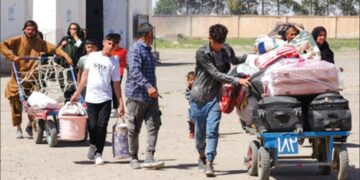
Fried’s testimony to Congress was the most detailed description to date of what is going on in Baghdad with the Mojahedin-e Khalq where more than half of its 3,400 members have so far been transferred from Camp Ashraf, which is run by the Mojahedin-e Khalq, to Camp Hurriya, which is run by the Iraqi government.
“The process of relocating residents to Hurriya has had challenges,” Fried said in a diplomatic understatement.
“Accompanying each convoy are UN human rights monitors, who also observe the screening of residents and property as each convoy loads from Camp Ashraf and provide useful, neutral reports following each convoy movement. The preparation of each convoy is lengthy and disagreements, sometimes heated, have occurred between the Iraqi authorities and the residents about cargo, screening procedures and other issues,” he said.
“Given the history of Camp Ashraf, the emotions involved, and the fact that many of those at Camp Ashraf have resided there for years, this should not surprise us. Indeed, the fact of continued progress is more remarkable than the difficulties.”
Fried told the committee, “Living conditions at Camp Hurriya have also had their challenges. Camp Hurriya, when under US control, was part of the largest coalition base in Iraq, housing thousands of American and coalition forces during military operations in Iraq. The containerized housing units (CHUs), which the former Ashraf residents now occupy, previously housed our service personnel.
“Hurriya also includes among its living spaces a large dining facility, fitness facility, a mosque, and recreational space for the residents. The UN studied the infrastructure before the first convoy and judged that the facility met or exceeded international humanitarian standards for such encampments to support the relocation of all Ashraf residents.
“Nevertheless, some legitimate concerns were raised about conditions at Hurriya. There were early issues with water, sewage and electric power, though many of these have been resolved. There were early concerns about the location and size of Iraqi police units at Camp Hurriya, though here, too, a satisfactory resolution was worked out. Both Camps Ashraf and Hurriya have Internet connectivity to the world.”
He said UN monitors visit Camp Hurriya “daily” while US embassy officers visit “frequently” to check on conditions. But there is no UN or US presence 24/7.
“Still, some issues remain,” Fried continued. “For example, greater attention needs to be paid to the repair of air conditioning units by the government of Iraq, and other basic welfare needs, such as accommodations for the disabled, ought to be addressed. With the onset of hot weather, requirements of electric power and water deliveries will increase, and the number of needed utility vehicles for provision of water and removal of sewage therefore will grow.”
Fried then signaled some frustration with the way the Mojahedin members have conducted themselves: “The residents, meanwhile, need to engage with the Iraqi government, the UN, and others on these serious issues in a focused manner,” he said
Late in his testimony he shifted what is the core issue of the whole exercise: “We must not lose sight of our purpose: the relocation of Camp Ashraf residents out of Iraq. The way for residents out of Iraq lies through the UNHCR [refugee application review] process.”
Fried said, “For our part, the United States has informed the UNHCR and our international partners that we will receive UNHCR’s referrals of some individuals. These referrals will be reviewed on a case-by-case basis, consistent with applicable US law. Other governments have stated their intention to take similar actions, and some have begun the process of reviewing residents.”
He said, “Some in Camp Hurriya may choose to return voluntarily to Iran. Others may find that they have credentials and connections to European or other nations and can resettle there. Still others will require resettlement as refugees or other permission to reside in third countries through the UNHCR’s good offices. Some of our European partners have already indicated that they will interview residents to determine eligibility for resettlement within their respective countries.”