












February 28, 2020
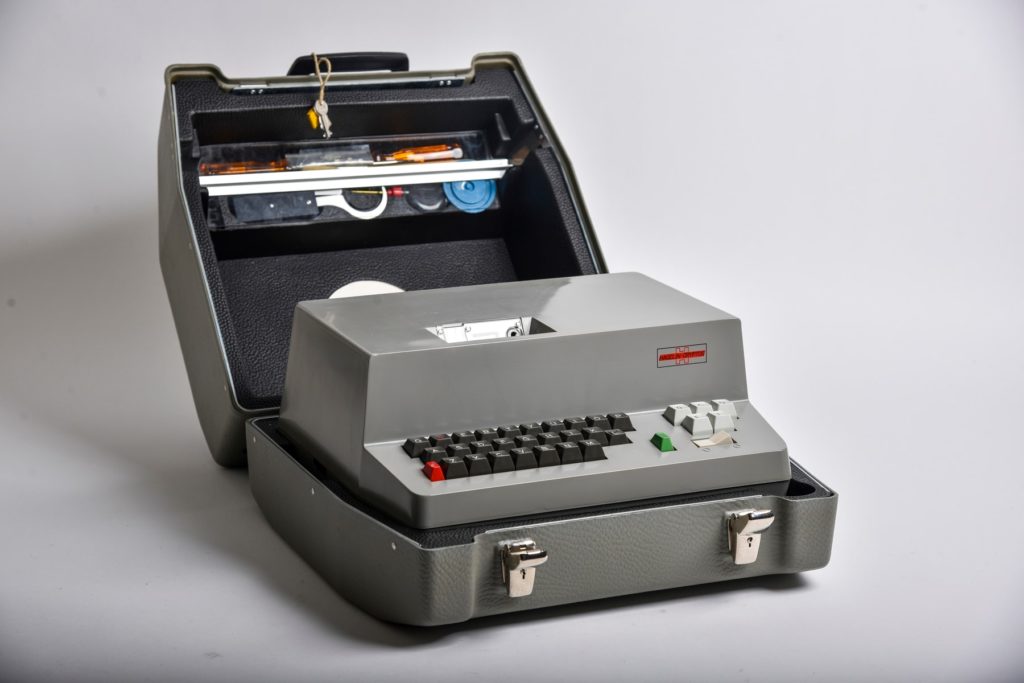
The Islamic Republic used encoding machines for decades that the United States was reading daily—and even continued to use them when the world became suspicious of the machines, The Washington Post has reported.
The machines were made by a Swiss company owned and controlled by the US and West German intelligence agencies. They were sold to about 120 Third World countries, but one CIA source told the Post that the Islamic Republic was the “most lucrative” target of the entire bunch, with US officials often reading stacks of Iranian secret messages just hours after they were sent.
What finally ended the US ability to spy on Iran through the machines was, oddly, US sanctions, which blocked the Swiss firm’s business with Iran!
The Swiss firm, Crypto AG, used encoding equipment designed by the CIA so it could easily break the codes. The system finally came to an end when the modern Internet made codes widely available and the firm’s near monopoly came to an end in recent years. The CIA folded the program and sold off Crypto AG in 2018.
The decades-long arrangement, among the most closely guarded secrets of the Cold War, is laid bare in a classified, comprehensive CIA history of the operation obtained by The Washington Post and ZDF, a German public broadcaster, in a joint reporting project.
“It was the intelligence coup of the century,” the CIA report concludes.
America’s main adversaries, including the Soviet Union and China, were never Crypto customers. But the firm’s machines dominated in the Third World.
The Post said it had access to two key documents. The first is a 96-page account of the operation completed in 2004 by the CIA’s Center for the Study of Intelligence, an internal historical branch. The second is an oral history compiled by German intelligence officials in 2008.
At times, the reports indicate, Crypto accounted for roughly 40 percent of the diplomatic cables and other transmissions by foreign governments that cryptanalysts at the US National Security Agency (NSA) decoded and mined for intelligence. Germany was even more dependent, with Crypto machines giving it 90 percent of the documents it used to analyze the world.
Bobby Ray Inman, who served as director of the NSA and deputy director of the CIA in the late 1970s and early 1980s, told the Post, “It was a very valuable source of communications on significantly large parts of the world important to US policy-makers.”
The program got going slowly after World War II. It didn’t move into high gear, however, until 1967, when Crypto rolled out a new, all-electronic model, the H-460, whose inner workings were completely designed by the NSA.
After Iranian militants stormed the US Embassy in 1979 and took 52 American hos-tages, the Carter Administration sought their release in back-channel communications through Algeria. Inman, who served as NSA director at the time, said he routinely got calls from President Jimmy Carter asking how Ayatollah Khomeini’s regime was reacting to the latest messages.
“We were able to respond to his questions about 85 percent of the time,” Inman said. That was because the Iranians and Algerians were both using Crypto devices.
In 1981, the CIA report said, Saudi Arabia was Crypto’s biggest customer, followed by Iran, Italy, Indonesia, Iraq, Libya, Jordan and South Korea.
President Ronald Reagan jeopardized the Crypto operation when he implicated Libya in the 1986 bombing of a West Berlin disco popular with American troops. Two US soldiers and a Turkish woman were killed in the attack.
Reagan ordered retaliatory strikes against Libya 10 days later. The president then publicly said evidence showed that Libya’s embassy in East Berlin received orders to carry out the attack a week before it happened. Then, the day after the bombing, “they reported back to Tripoli on the great success of their mission.”
Reagan’s words made clear that Tripoli’s communications with its station in East Berlin had been intercepted and decrypted. But Libya wasn’t the only government that took note of the clues Reagan had provided.
Iran, which knew that Libya also used Crypto machines, became increasingly concerned about the security of its equipment, the CIA report said. Oddly, however, Tehran didn’t act on those suspicions until six years later.
US spy agencies intercepted Iranian communications sent via Crypto machines during the eight-year war with Iraq, mining them for reports on subjects such as Tehran’s terrorist links and attempts to target dissidents.
The CIA said the Islamic Republic was its “the most lucrative target” in the entire world because it continued to reply heavily on the Crypto machines.
Iran’s communications were “80 to 90 percent readable” to US spies, according to the CIA document, a figure that would probably have plunged into the single digits had Tehran not used Crypto’s compromised devices.
In just the single year of 1988, the CIA report says, more than 19,000 intercepted Iranian messages were used by the agency in its analyses for policy-makers, “covering everything from hostage issues to the Iranian conflicts with other Persian Gulf states.
In 1992, however, the Crypto operation faced its first major crisis: Iran, belatedly acting on its long-standing suspicions, detained a company salesman.
Hans Buehler, then 51, was considered one of the company’s best salesmen. Iran was one of the company’s largest contracts, and Buehler had traveled in and out of Tehran for years. There were tense moments, including when he was questioned extensively in 1986 by Iranian officials after the disco bombing and Reagan’s remarks.
Six years later, he boarded a Swissair flight to Tehran but failed to return on schedule. When he didn’t show, Crypto turned for help to Swiss authorities and was told he had been arrested by the Iranians. Swiss consular officials allowed to visit Buehler reported that he was in “bad shape mentally,” according to the CIA history.
Buehler was finally released nine months later after Crypto agreed to pay Iran $1 million, a sum that was secretly provided by the BND, West Germany’s spy agency, according to the documents. The CIA refused to chip in, citing the US policy against paying ransom.
Buehler knew nothing about Crypto’s relationship to the CIA and BND or the vulnerabilities in its devices. But he returned traumatized and suspicious that Iran knew more about the company he worked for than he did. Buehler began speaking to Swiss news organizations about his ordeal and mounting suspicions.
Amid the publicity, at least a half-dozen countries — including Argentina, Italy, Saudi Arabia, Egypt and Indonesia — either canceled or suspended their Crypto contracts.
Astonishingly, Iran was not among them, according to the CIA file, and “resumed its purchase of equipment almost immediately.” Iran, the report said, “was one of the few countries that showed little reservation.”
So, the intelligence kept coming, current and former officials said, in part because of bureaucratic inertia in Iran.
A few days after the story was published, Iranian Foreign Minister Mohammad-Javad Zarif was asked about it while visiting Germany. He indicated that Iran didn’t figure out that the Crypto machine was a window into Iran. He said Iran’s dealings with the Swiss company ended about 20 years ago only because US sanctions forced the firm to cease its business with Iran.
Many governments just never got around to switching to newer encryption systems proliferating in the 1990s and beyond — and unplugging their Crypto devices. This was particularly true of less developed nations, according to the documents.
But, by 2018, the long run was over. The CIA sold off Crypto AG and closed the operation. It isn’t known how the CIA now reads communications from the Islamic Republic or how much it can read.