








Despite a clear desire to abandon all efforts to make Iran self-sufficient in various kinds of food, the Rohani Administration has caved in to revolutionary pressures and proclaimed that it will make Iran completely self-sufficient in eight essential agricultural products within a decade.
One of those products is wheat, which most economists say is impractical for Iran to produce in sufficient quality for the entire country. Economists generally say Iran should reduce the area already devoted to wheat and import more from counties that can produce it cheaply.
Another is rice, which requires vast amounts of water and can only be grown in the far north near the Caspian Sea. Rice used to be a daily food only for the rich, with the poor rarely consuming it except on holidays and festivals. But in recent decades, the demand for rice has soared and much of it has had to be imported. The government said it would provide support for rice farming only in Gilan and Mazandaran provinces on the Caspian coast, which would have to become vast paddies to supply all of Iran.
The other crops targeted for self-sufficiency by 2015 are barley, maize, pulses, sugar beets, oilseeds and cotton.
In some cases, the government plans to substantially increase the area under cultivation. For example, to produce more cotton, the plan says the area under cultivation will grow by almost half from today’s 70,000 hectares to 100,000.
But when it comes to barley, the government says no more land will be devoted to that crop. Instead, production per hectare will be boosted from three tons per hectare to as much as 4.5 tons, a 50 percent jump.
To boost output of pulses, the Agricultural Ministry said it would resort to modernization of farming techniques, research on more suitable crop varieties and supporting farmers with insurance.
Whether any of this is realistic remains to be seen. But the goals are made harder by the severe water shortage that Iran now faces. More than 90 percent of Iran’s water consumption goes to agriculture. Iran’s population is growing and its water supply is shrinking. That is not a formula for self-sufficiency in food.
But a long-time revolutionary goal has been autarky, or self-sufficiency, a goal encouraged by the fears of hardliners that Iran’s “enemies” will cut off food supplies if the country becomes dependent on imports. Of course, Iran is dependent and has long been dependent on food imports, but no cutoffs have been promoted.
The Ahmadi-nejad Administration made a big push for autarky. The year 2006 was the year of big promises of self-sufficiency. Agriculture Minister Mohammad-Reza Eskandari was busy proclaiming approaching self-sufficiency in many foods. He said in April of 2006 that Iran would become self-sufficient that year in red meat. In May, he said the country would be self-sufficient in wheat (again) that year, in barley the next year, in maize and rice within two years, in sugar within three years and in vegetable oils within four years. None of those predictions ever materialized.
As recently as this past April, the Rohani Administration pushed aside the effort to make the country self-sufficient in wheat, the single most important product that the revolutionary zealots want to see grown entirely within Iran.
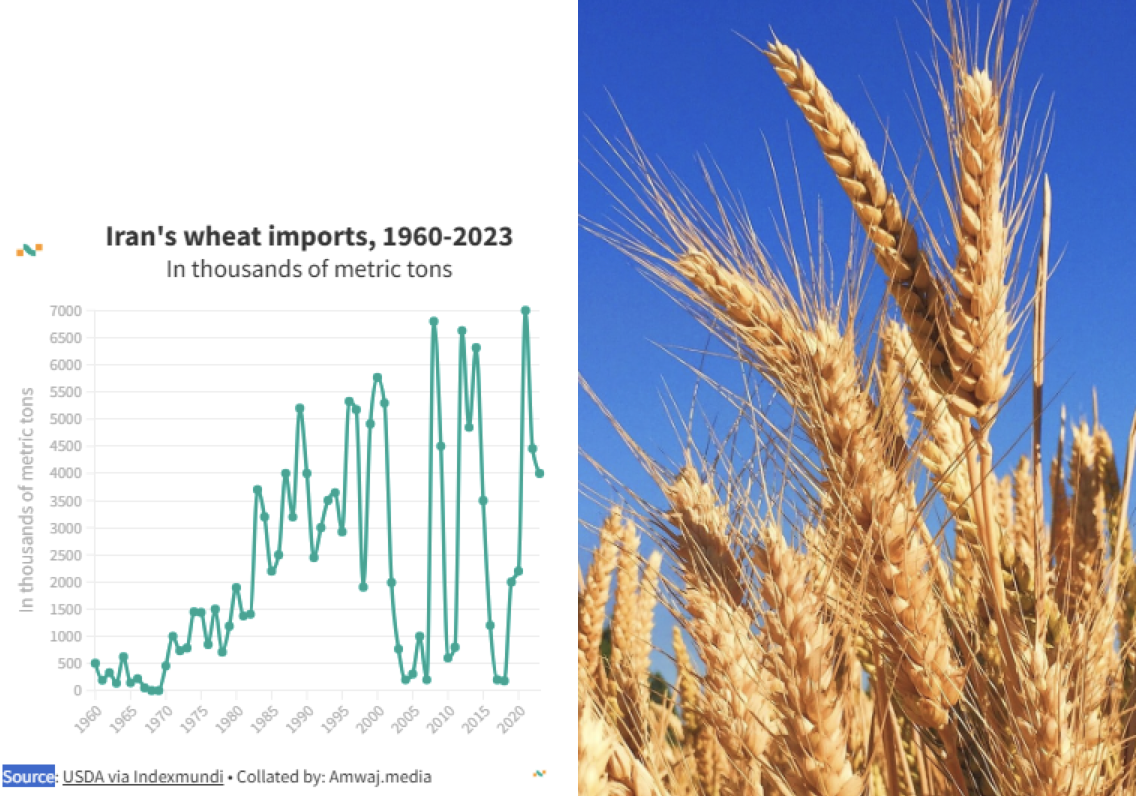
The Islamic Republic has been self-sufficient in wheat production for only a single year, about a decade ago. Agriculture Minister Mahmud Hojati said in April that the government planned to shrink wheat acreage by 900,000 hectares over the next decade and dedicate that land to canola, which consumes much less water. Now, it appears that plan has been overridden by revolutionary zealots. Presumably, they have had the endorsement of the Supreme Leader; otherwise the Rohani Administration could just brush their demands aside.
However, some suspect the announcement of self-sufficiency in eight products is just “press release policy”—that is, that the government is announcing the goals but will do nothing about them.
The revolutionary philosophy of self-sufficiency or autarky holds that the country must be capable of producing everything it needs so it is not dependent on any imports. The revolutionary worldview holds that a dependency on imports makes Iran subject to unacceptable pressures from foreigners.
Most of the rest of the world has shifted to the concept of “interdependency,” in which countries have a shared dependency on one another and thus a shared interest in stability and in one another’s prosperity. The Islamic Republic adheres to what critics assail as a 19th Century worldview of international affairs as a zero-sum game in which one state can prosper only at another’s state’s expense.
While the official position of the Islamic Republic is autarkic, many within the regime disparage that whole concept as a silly policy—in fact, a dangerous ideology. But few dare speak out publicly against it.
Back in 2007, Issa Kalantari, who was agriculture minister under President Khatami, said the Ahmadi-nejad Administration’s “obsessive” drive for autarky was self-defeating. He said that as more and more land was diverted to wheat cultivation, the production of cattle feed, cotton, potatoes and grains has suffered, sending prices higher and requiring more imports of those goods.
Wheat is heavily subsidized because it is the staple of the Iranian diet. Wheat is so cheap in Iran that many farmers buy bread to feed to their chickens and sheep because bread is cheaper than animal feed. Kalantari said the government was then paying farmers $200 a ton for wheat and selling flour to bakers at $50 a ton.
Mansur Bitaraf, an agricultural economist, told the Financial Times Deutschland, “This [wheat] self-sufficiency drive has been at the cost of other products, like barley, which has lost lands to wheat production. This has indirect impacts on other foods like red meat, because barley is also used as cattle feed.”
The self-sufficiency drive began many years ago. It is an ideological lodestar for the revolutionary regime. But the Financial Times Deutschland said the Rafsanjani and Khatami administrations “appeared to be pursuing the policy grudgingly,” in recognition of the dangers.
Under the Ahmadi-nejad Administration, however, that changed and the Agriculture Ministry was set at full speed ahead on autarky.
Iran first said it reached self-sufficiency in wheat in 2004 under Khatami. But imports actually resumed, albeit at a low levels, in 2005 and continued at higher levels in every year since then.
In January 2006, Supreme Leader Ali Khamenehi pressed farm leaders to make Iran self-sufficient in all foods so the Islamic Republic is not subject to pressure from “bullies.”
“Today, when our country is the subject of ill will and vindictiveness from the bullies of the world,Ö the country needs to have food security—for its bread, for its daily food, for its cooking oil, for its meat—not to be dependent on other countries, not to be dependent on those who can demand its honor in exchange for these goods.”
Khamenehi said that under the Shah other countries, unnamed, tried to make Iran dependent on them for food in order to have markets for their wheat and other products. The United States is a major wheat exporter.
Many agricultural specialists say self-sufficiency in most agricultural fields is not even a reasonable goal for Iran given its frequent droughts and erratic climatic conditions. Economists almost universally scoff at autarky as an economic principle discredited long ago. They stress inter-dependence with countries exporting those goods for which they have a natural advantage and importing those goods for which others have a natural advantage.
The zealots in Iran point out that the United States barred all exports to Iran, including food, from 1995 to 1999, underscoring what they see as a need for self-sufficiency. As a practical matter, however, economists say food embargoes are meaningless because too many countries produce food for export; if Country A stops wheat sales to Country Z, then Countries B thru J will swiftly line up to supply Country Z, so that Khamenehi’s horrific vision is not a serious threat.
But despite that, autarky has a popular appeal with citizens in many countries—including the United States, although officials in the United States do not advocate autarky and just brush aside its vocal advocates, treating them as crazies.