








• About Us
  • Subscription
  • Contact Us
Saturday, March 7, 2026
  • Login
Iran Times
  • Home
  • What’s the News
    • All
    • baygani
    Army Says It Makes Some Officers UN Peacekeepers

    Army Says It Makes Some Officers UN Peacekeepers

    Iran May Curry Favor With Egypt By Axing Street Name

    Iran May Curry Favor With Egypt By Axing Street Name

    Regime Barks Loudly At Dog Owners

    Regime Barks Loudly At Dog Owners

    Campaign To Rid Iran of Afghans Moves Into Trumpian High Gear

    Campaign To Rid Iran of Afghans Moves Into Trumpian High Gear

    Russia, China Interfere To Stunt Iran Nuclear Plan

    Russia, China Interfere To Stunt Iran Nuclear Plan

    Regime Hangs Convicted Killer of 7 in 2022 Protests

    Regime Hangs Convicted Killer of 7 in 2022 Protests

    Trump Kicks Trio Off Iran Issues For Being Too Pro-Israel

    Trump Kicks Trio Off Iran Issues For Being Too Pro-Israel

    Omid The Siberian Crane May Have Died

    Omid The Siberian Crane May Have Died

    Israel Built Drones In A Factory Set Near Tehran

    Israel Built Drones In A Factory Set Near Tehran

  • Diaspora
  • Economy
    Economist Says Biggest Problem For Iranian Economy is State Controls

    Economist Says Biggest Problem For Iranian Economy is State Controls

    US Stops Turkmen Gas Crossing Iran For Iraq

    US Stops Turkmen Gas Crossing Iran For Iraq

    For Umpteenth Time, Auto Privatization Again Killed

    For Umpteenth Time, Auto Privatization Again Killed

    China Oil Buy Drops, But Remains High

    China Oil Buy Drops, But Remains High

    Gov’t Ends Ban Importing Goods Made In Iran

    Minimum Wage is Boosted 45%

    Banks Must Keep More Money On Hand

    Banks Must Keep More Money On Hand

    Russian Says Iran Watermelons Unsafe

    Russian Says Iran Watermelons Unsafe

    Iran Not To Be Self-Sufficient In Wheat This Year

    Iran Not To Be Self-Sufficient In Wheat This Year

  • Tidbits and Morsels
  • Latest
    Hell Comes To A Pasdar Base North of Tehran

    Hell Comes To A Pasdar Base North of Tehran

    US Mail To Iran Is Suspended

    President Takes Time Off For Surgery

    President Takes Time Off For Surgery

    After Month Of Talks, Trump Decides He Wants No Enrichment

    The Lights Are Going Out All Over Iran

    Drone Attack That Killed 3 US Troops in Jordan Could Have Been Foiled

    Iranian-Canadians Reportedly Turned Away at US Border

    Iranian-Americans: an Account of Integration and Achievement

    Jamshid Myth

  • About Us
  • Advertising
  • Subscription
No Result
View All Result
  • Home
  • What’s the News
    • All
    • baygani
    Army Says It Makes Some Officers UN Peacekeepers

    Army Says It Makes Some Officers UN Peacekeepers

    Iran May Curry Favor With Egypt By Axing Street Name

    Iran May Curry Favor With Egypt By Axing Street Name

    Regime Barks Loudly At Dog Owners

    Regime Barks Loudly At Dog Owners

    Campaign To Rid Iran of Afghans Moves Into Trumpian High Gear

    Campaign To Rid Iran of Afghans Moves Into Trumpian High Gear

    Russia, China Interfere To Stunt Iran Nuclear Plan

    Russia, China Interfere To Stunt Iran Nuclear Plan

    Regime Hangs Convicted Killer of 7 in 2022 Protests

    Regime Hangs Convicted Killer of 7 in 2022 Protests

    Trump Kicks Trio Off Iran Issues For Being Too Pro-Israel

    Trump Kicks Trio Off Iran Issues For Being Too Pro-Israel

    Omid The Siberian Crane May Have Died

    Omid The Siberian Crane May Have Died

    Israel Built Drones In A Factory Set Near Tehran

    Israel Built Drones In A Factory Set Near Tehran

  • Diaspora
  • Economy
    Economist Says Biggest Problem For Iranian Economy is State Controls

    Economist Says Biggest Problem For Iranian Economy is State Controls

    US Stops Turkmen Gas Crossing Iran For Iraq

    US Stops Turkmen Gas Crossing Iran For Iraq

    For Umpteenth Time, Auto Privatization Again Killed

    For Umpteenth Time, Auto Privatization Again Killed

    China Oil Buy Drops, But Remains High

    China Oil Buy Drops, But Remains High

    Gov’t Ends Ban Importing Goods Made In Iran

    Minimum Wage is Boosted 45%

    Banks Must Keep More Money On Hand

    Banks Must Keep More Money On Hand

    Russian Says Iran Watermelons Unsafe

    Russian Says Iran Watermelons Unsafe

    Iran Not To Be Self-Sufficient In Wheat This Year

    Iran Not To Be Self-Sufficient In Wheat This Year

  • Tidbits and Morsels
  • Latest
    Hell Comes To A Pasdar Base North of Tehran

    Hell Comes To A Pasdar Base North of Tehran

    US Mail To Iran Is Suspended

    President Takes Time Off For Surgery

    President Takes Time Off For Surgery

    After Month Of Talks, Trump Decides He Wants No Enrichment

    The Lights Are Going Out All Over Iran

    Drone Attack That Killed 3 US Troops in Jordan Could Have Been Foiled

    Iranian-Canadians Reportedly Turned Away at US Border

    Iranian-Americans: an Account of Integration and Achievement

    Jamshid Myth

  • About Us
  • Advertising
  • Subscription
No Result
View All Result
Iran Times
No Result
View All Result

Despite bombing, Sunni-Shia frictions in Kuwait are few

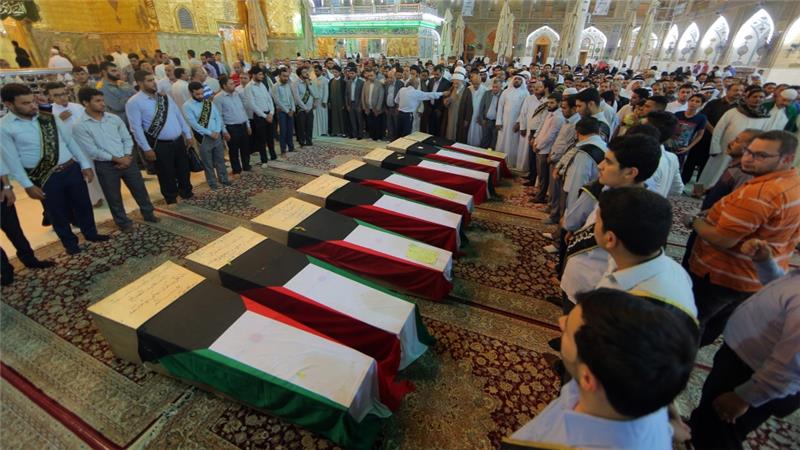
MOURNING — Kuwaiti Shias line up behind the coffins of some of those killed in the bombing.

The Friday suicide attack against a Kuwaiti Shia mosque, which killed 27 worshippers, has resulted in a flourishing of Sunni-Shia unity in Kuwait in strong contrast to the general trend to harsh anti-Shiism elsewhere in the Arab world.

The Islamic State has claimed responsibility for the attack.  But the solitary attacker wasn’t even a Kuwaiti.  The Islamic State had to bring in a Saudi suicide bomber to carry out the attack.

He entered a very large Shia mosque during Friday prayers and exploded his bomb at the very back of the mosque.  If he had walked forward into the middle of the mosque, the death toll would likely have been far higher.  Instead, much of the explosive force of his bomb was wasted against the mosque’s back wall.

The estimates of Kuwait’s Shia population range from 300,000 up to a third of the 1.3 million population of native Kuwaitis.

Historically, Kuwait’s Shia population has three different origins.

The first is Arabs native to the area, collectively referred to as the baharnah.  They were sea-faring peoples and Twelver Shias who inhabited Bahrain, Al-Hasa (the eastern coast of Saudi Arabia) and Kuwait.

The second source was Iranian migrants who moved to what is today Kuwait and Bahrain, some as far back as 300 years ago, while others came in a wave during the 1920s.

The third bloc of Kuwaiti Shias originated in southern Iraq and migrated a short distant southward into Kuwait.

According to Ibrahim al-Marashi, an assistant professor of history at California State University at San Marcos, these Shia Muslims have had “a relatively cordial historical relationship with the Arab Sunni Al Sabah family,” which has ruled over Kuwait since 1752.  Marashi calls it “a mutually beneficial client-patron relationship.”

After independence was gained in 1961, Marashi says the Kuwaiti Shia were active in the Kuwaiti National Assembly, inaugurating a pattern of Kuwaiti politics with shifting allegiances between the royal family and Shia parliamentarians against another shifting alliance of Kuwait’s Sunni merchants, notables, and intelligentsia.

This alliance ruptured as a result of the Iranian revolution in 1979 with rallies in Kuwait supporting the anti-monarchial revolution.

But Marashi cautions that these rallies were not simply Shia Kuwaitis inspired by a resurgent Shiism in Iran.  “Even Kuwaiti Sunni political Islamists were inspired by the revolution, and allied with Kuwaiti Shia to augment their strength vis-a-vis the royal family and state,” Marashi writes for the English outlet of Al-Jazeera.

Still, the alliance of the Shia community and the royal family was shattered.  The government responded by gerrymandering election districts to reduce the Shia presence in the National Assembly.  It also exiled Sayyid Abbas Mohri, a prominent Kuwaiti Shia activist.

Marashi writes, “The issue of loyalty became a significant issue during the Iran-Iraq war, when the state was concerned about Shia susceptibility to Ayatollah Khomeini’s activist revolutionary ideology, which was by no means merely sectarian, but a pan-Islamist doctrine to unite and rally both Shia Muslims and Sunnis against conservative and pro-US regimes in the Middle East.”

On top of that, Kuwait became a battleground during the Iran-Iraq war. Bombings, an airplane hijacking and an assassination attempt on Crown Prince Jabir were carried out by Iraqi and Lebanese Shia to retaliate for Kuwait’s support of Saddam Hussein.

In January 1987, 12 Kuwaiti Shia Muslims were arrested after more bombings.  Marashi says that triggered “a significant shift in Kuwaiti Shia dissatisfaction with the government,… [though] they by no means constituted a systemic pattern among the local Kuwaiti Shia community.”

After the Iraqi invasion of Kuwait in 1990, the ties between the Shia and the state were reconciled. Kuwaiti Shia of Iranian ancestry took part in the Kuwaiti resistance against the Iraqi occupation.

After the expulsion of the Iraqis, the Kuwaiti Shia resumed their old role in parliament and once again were relied upon by the Kuwait royal family as allies.

This rosy relationship doesn’t mean sectarian sentiment is totally absent in Kuwait. Just last month, one Kuwaiti Shia MP resigned after a sectarian slur was hurled at him by a Sunni MP. But the sectarian frictions are muted compared to much of the rest of the Arab world.

After the mosque bombing, Kuwait’s Sunni Emir visited the blood-soaked Shia mosque.  Photos of Kuwaiti Shias and Sunnis praying together in each other’s mosques circulated widely and were seen as a repudiation of the sectarianism the Islamic State tried to incite in Kuwait.

Marashi concludes:  “The Kuwaiti Sunni response in the aftermath of this attack has served as a powerful rejoinder to the persistent primordial assumptions of ‘ancient-sectarian hatred’ as something that is integral to the region, existing since time immemorial.”
Previous Post

Gov’t says it will revive mothballed LNG plans

Next Post

China tells its Muslims to forget Ramadan

Related Posts

Faith

Religious repression growing in Iran

London overwhelmingly elects a Muslim mayor
Faith

London overwhelmingly elects a Muslim mayor

She’s a well-covered Olympia
Faith

She’s a well-covered Olympia

Next Post
China tells its Muslims to forget Ramadan

China tells its Muslims to forget Ramadan

Don’t let the deadline drive the deal

Leave a Reply Cancel reply

Your email address will not be published. Required fields are marked *

  • About Us
  • Contact Us
  • Advertising
  • Subscription
  • Culture
  • Economy
Call us: +1 (202)-659-9868

© 1970-2025 Iran Times - ‬An‭ ‬Independent‭ ‬Newspaper

Welcome Back!

Login to your account below

Forgotten Password?

Retrieve your password

Please enter your username or email address to reset your password.

Log In
No Result
View All Result
  • Home
  • What’s the News
  • Diaspora
  • Economy
  • Tidbits and Morsels
  • Latest
  • About Us
  • Advertising
  • Subscription

© 1970-2025 Iran Times - ‬An‭ ‬Independent‭ ‬Newspaper

Are you sure want to unlock this post?
Unlock left : 0
Are you sure want to cancel subscription?
Go to mobile version