

June 20, 2025
Archaeologists in Iran have uncovered the cone-shaped skull of a young woman who died more than 6,000 years ago, revealing evidence of both a fatal injury and an ancient practice of skull reshaping.
The remains were unearthed at Chega Sofla, a prehistoric burial site near the northern end of the Persian Gulf, about 30 miles south of Behbehan. The site, dating back to between 4700 and 3700 BCE, contains both individual graves and family tombs.
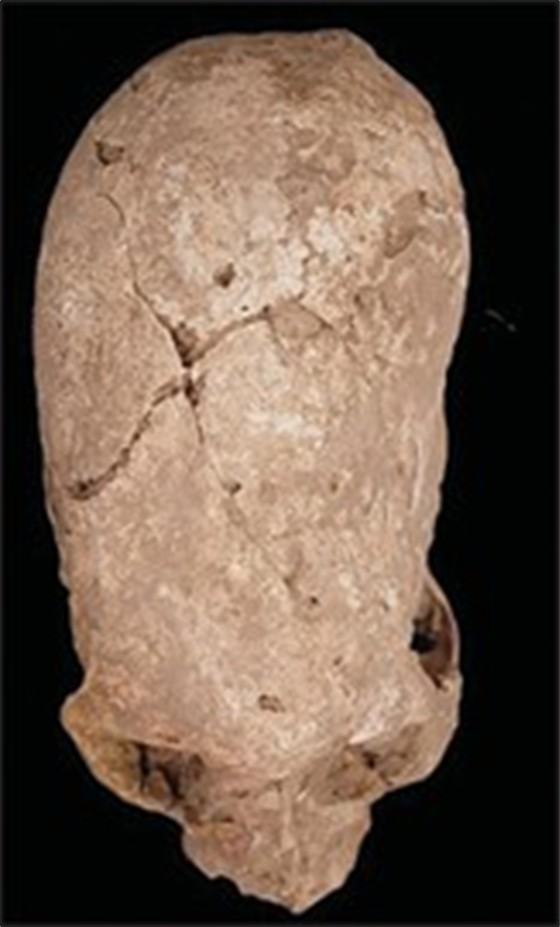
. . . seen from the back
The discovery is part of the Zohreh Prehistoric Project, led by archaeologist Abbas Moghaddam. The team has worked at Chega Sofla for over a decade and uncovered the world’s oldest examples of brick tomb construction, along with several elongated skulls.
In a study published May 22 in the International Journal of Osteoarchaeology, researchers Mahdi Alirezazadeh and Hamed Vahdati Nasab of Tarbiat Modares University focused on the cone-shaped skull of a female teenager.
Her head had been reshaped through a practice known as cranial bandaging, which involves wrapping a child’s skull in fabric to change its shape over time, presumably to make a woman more attractive, fitting the standards of the era.
Researchers believe the cranial modification may have made her skull more fragile and less able to withstand heavy impact.
A triangular fracture stretched from the front to the left side of her head. The injury, likely caused by a strong blow from a wide-edged object, occurred shortly before death.
“We know this woman experienced the fracture in the final moments of her life,” Alirezazadeh said. “We don’t have any direct evidence to say that someone intentionally struck her.”
Alirezazadeh emphasized that skull reshaping may not have been the only reason for the young woman’s injuries. Another fractured skull found at the site showed no signs of cranial modification. “So, we cannot attribute cranial fractures solely to modified skulls,” he said.
The skull was buried in a communal grave, making it difficult for archaeologists to identify the rest of her skeleton. This has limited further research into how she lived and died in one of the most transformative periods of early human settlement in the region.
The Zohreh Prehistoric Project has focused on understanding the social and cultural developments of early Iranian communities. In addition to graves, the team has uncovered domestic structures, tools and pottery that paint a broader picture of life during the Copper Age.